Historical Recipes and Cookbooks

The holiday season is characterized by large meals, lavish spreads of specialty dishes, and family traditions. Below you’ll find a selection of recipes from the history of the Eastside. Try one and share your dish with us! Email a picture of your creation to our Collections Manager to be featured on our social media pages.


1950 Ford Treasury of Favorite Recipes from Famous Eating Places

The cookbook lists restaurants throughout the United States. Each page describes one restaurant, and includes an illustration and a recipe from that establishment.

Pound steak with tenderizer. Pour flour into shallow pan; add salt and pepper. Press steak into flour mixture and turn several times. Melt shortening in heated Dutch oven (425°). Brown steak well on both sides, then add chopped onion. Mix mushroom soup with equal parts of water, stir well, and pour over steak. Turn fire down to 350° and let simmer for 2 hours. Add more water if necessary. Serves 4 to 6.

Dutch Oven Steak

2 pounds round steak, 1 inch thick

1 cup flour

1 tablespoon salt

1 teaspoon black pepper

1/2 cup shortening

1 large onion, chopped fine

1 can mushroom soup


1962 Favorite Recipes from Faraway Places

Century 21/Seattle World's Fair Souvenir Cookbook. The book was printed by Frederick and Nelson and Revere Ware.

Pour mixture over 4 pork chops - 1” thick.

Let stand for 24 hours.

Remove chops and brown in Revere 10” Skillet.

Pour Vinegar mixture over chops and cook until chops are tender.

Garnish with 4 slices pineapple and 4 maraschino cherries.

Pork Chops Tahitian

Mix Together:

3/4 cup vinegar

1/2 cup soy sauce

3/4 cup brown sugar

2 tablespoons dry mustard

4 cloves garlic


1916 Jell-O, America's Most Famous Dessert

In addition to the recipes, this book tells the story of a new bride and how she uses Jell-O to cook dinner for her new husband, entertain, and cook for her children.

Thrifty Salad

Dissolve one package of Lemon Jell-O in one pint of boiling water. When cold, put a shallow layer in bottom of mould, and when partly set, place in sliced tomatoes. Fill mould with alternate layers of salmon, cold cooked peas and cold Jell-O. Serve on bed of lettuce leaves, garnished with tomatoes, adding French dressing or mayonnaise.


A History of Snoqualmie: Finding Funds for a Road by Lobbying, Taxing, and Swindling

Eastside Stories is our way of sharing Eastside history through the many events, people places and interesting bits of information that we collect at the Eastside Heritage Center. We hope you enjoy these stories and share them with friends and famil…

Eastside Stories is our way of sharing Eastside history through the many events, people places and interesting bits of information that we collect at the Eastside Heritage Center. We hope you enjoy these stories and share them with friends and family.

Eastside Stories

Much of the construction of the road through Snoqualmie Pass was driven by money. Originally a desire of local citizens, the project would eventually attract federal funding. Economic opportunities convinced private citizens early on of the need for an easily traveled road, but the US government’s reasons hinged on military defense.

As early settlers sought to attract both travelers and those hoping to set up residence, finding funds for the project was of utmost importance. The Seattle area settlers hoped to attract more people to the region and capitalize on those traveling to other parts of the west. Still, finding funds required creative thinking and patience as the project experienced several setbacks.

After Governor Steven’s two exploratory parties, The Puget Sound War of 1855 both halted construction and encouraged further exploration of the region. Although the war interrupted its construction, in the end it would be a driving force for federal funding. Major J.J.H. Van Bokkelen felt that to deter attacks from Native American groups to the east of the Seattle area on the growing population of the Seattle area a military highway was needed. He documented topographical information himself to locate strategic sites for the establishment of military encampments.

After the war military desires and a new economic opportunity further encouraged the Snoqualmie Pass project. In 1859 the Gold Rush inspired many to come west seeking fortune and the construction of a road by Snohomish county settlers across Cady pass just a little north of Stevens Pass. This is also the year that Seattle used $1,050 to appoint a superintendent of roads and started again on their project to build a road across Snoqualmie Pass. Fortunately for them soon after this Bokkelen’s ideas made it to Washington. Congress secured funds in 1860-1861 to build a road through the Cascades for military movements. They gave $75,000 for the project, but the Civil War soon interrupted the construction yet again.

Photo (above) :Snoqualmie Pass Road - planked or corduroy road through the woods. Photographed by King County Public Works.

Photo (above) :Snoqualmie Pass Road - planked or corduroy road through the woods. Photographed by King County Public Works.

Still desiring a road that would route settlers towards Seattle, in 1875 Seattle businessmen lobbied for legislature to allow them to hold a “grand lottery”. The group would sell 5-dollar tickets to raffle off Henry Yesler’s $100,000 sawmill. Unable to sell their goal of 60,000 tickets the lottery dragged on until it was declared illegal by the courts. It is thought the promoters of the lottery profited more than the road and construction remained slow.

Finally, citizens collected $2,500 to start again and construct a 25 mile road. W. W. Perkings worked from July till November with 20 men to open road. Workers labored manually and were constantly foiled by falling trees and other obstacles. Cutting brush and other debris by hand, bridges were also constructed by brute force with cedar planks. The first party that built the road with hard labor named Rattlesnake Prairie for the Camas seed pods that rattled there in the wind. They were also the first to report seeing chunks of coal in the pass which would inspire later entrepreneurs. The early work done by these 20 men would allow travel time to be cut from days to minutes as the road progressed to what it is today. From beginning to end the construction of Snoqualmie pass roads and eventually highway has been fueled by economic concerns.

Resources

Eastside Heritage Center Archives

Automatic Voting Machine Corp. Instruction Model.

As we draw nearer to the 59th quadrennial presidential election, let’s take a look at a piece of election history.

1997BHS.26.020

1997BHS.26.020

This is our Automatic Voting Machine Instruction Model. Added to the collection in 1997, this machine was probably used in the 1950s.

This demonstration device would have been available at the polling place for poll workers to show voters how to place their votes before they entered the privacy of the large voting booth.

When using the full voting machine, a voter would enter the machine and pull a lever to close the curtain. The voter would then make their selection from an array of small voting levers denoting the appropriate candidates or measures. The machine would lock out other candidates when one candidate's lever is turned down. When the voter was finished, they pulled a lever which opened the curtain and reset the machine.

Mechanical lever voting machines were first officially used in 1892. By 1930, they were in use in virtually every major American city, and by the 1960s well over half of votes in U.S. elections were cast on these machines.

These days, Washingtonians don’t have to use mechanical levers to cast their votes. Mail in voting was made available as a permanent part of our election process in 2005.


Election day is November 3rd this year and EHC encourages everyone to make their voices heard.


Fact Sheet Courtesy of the Washington Secretary of State

Fact Sheet Courtesy of the Washington Secretary of State


Resources:

The History of Elections and Voting in Washington. (n.d.). Retrieved September 08, 2020, from https://www.sos.wa.gov/elections/timeline/index.htm Washington Secretary of State

Bird, W. L., Jr. (2004, July 16). The Gear and Lever Voting Machine. Retrieved September 08, 2020, from https://americanhistory.si.edu/vote/votingmachine.html

Historical, Political, 1956 Presidential Election Voting Machine, Instruction Model. (n.d.). Retrieved September 08, 2020, from https://www.georgeglazer.com/wpmain/product/historical-political-1956-presidential-election-voting-machine-instruction-model/

The Colman Diaries

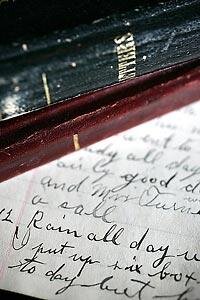
In 2005, Eastside Heritage Center was given a set of diaries. The Colman Diaries, as they are now known, are a rare treasure and a glimpse into the life of a woman who history might have forgotten otherwise. Written by Clarissa Colman and spanning nearly 30 years, they tell the story of her life on the Eastside.

James Colman

James Colman

Her early years are accessible to us largely through census records. Born Clarissa Denison in New York in 1832, married to James Colman in Iowa in 1859, and living in King County, WA by 1880. It isn’t until the tragic murder of her husband that Clarissa begins her journal. Nearly a year after his death, Clarissa records all she can remember of the period immediately leading up to his murder and the court cases that followed. After the State Supreme Court overturns the conviction of the suspected killer, she processes her grief in the pages of her diary.

This is the 30th anniversary of my wedding day. Three years on the 8th since James was murdered & still that man Miller is living here on the lake, in sight of our place. I wonder how much longer I shall have to wait for justice. Oh:: Lord, how long.
— Friday February 15th, 1889

Over the years she records her daily life as a widow and a mother. She cooks, manages their household, and takes note of the weather. She sells goods to the local stores, invests in property in Seattle, and successfully sues a railroad company. She mourns the loss of a grandchild and struggles with estrangement from her youngest son. In her writings we’re able to see a whole, complex person. A woman who is exceptional and ordinary; her story both familiar and remarkable.

2003151135.jpg

These diaries are a primary source, a document that contains observations and insights recorded firsthand by people of the time. These are the cream of the crop when it comes to historical research. Documents like these inform us as historians about the impact that major historical events have on real people. They give context to facts. For example, in 1889 Clarissa describes seeing fire and smoke from the direction of Seattle. She was witnessing the Great Seattle Fire from the shores of Lake Washington.

The big smoke we saw was Seattle in flames. The whoe [sic] business part is burnt. Dan Murphy came down this morning for hay ^ told us.
— Friday June 7th, 1889

While she never intended for her words to be read by strangers, her work has allowed us a peek into life on the Eastside at the turn of the last century.


Special thanks to the Fawcett family for the donation of these Diaries.


Resources:

Colman Diaries. 2005.017 Gift of Clarissa Fawcett, Robert Fawcett, George Fawcett, and Greg Fawcett in memory of Clarissa Colman and James Colman.

Ancestry.com

Grindeland, S. (2006, August 5). 1800s diary tells of murder mystery, life on Eastside. The Seattle Times, pp. A1, A13.

Archaeology Around Japanese American Communities at Barnestown

Edited by David R. Carlson

Around 1898 to 1924 a small town existed in southeastern King County known as Barnestown. This town was created for sawmill and lumber workers recruited to work in the area. Building towns like this allowed workers and their families to live in a community and enjoy some comforts in between hard labor. The needs of workers and their relations is why a store, bathhouse, and school were all built. The buildings have since been taken down by the Kent Lumber Company and the lumber sold, but remnants of Barnestown’s occupants, can still be found today. The material objects left behind are clues about how Japanese Americans there spent their days and the kind of changes and pressures they faced living in a new land.

 Recently, University of Washington PhD student David R. Carlson has conducted archaeological research into the site focusing on Issei (first generation) and Nissei (second generation) Japanese Americans who lived and worked at Barnestown. By first conducting a surface survey and then excavation, Carlson and his team explored what material culture was left behind to tell about the Japanese American laborers lives and some of their experiences around adapting the life in the USA, labor relations, and racial discrimination. From documented histories about our region we know that adjusting to life in the USA was not easy for many immigrant groups, mainly because of the discrimination they often faced. For Japanese American laborers bigotry took the form of pay inequality, legal exclusion from settlement, and even outright violence. By looking at written records and the layout of the town of Barnestown, Carlson was able to create a workplan that could potentially shed light on the day to day experiences of Japanese Americans in sawmill towns like this. Carlson hopes to discover this and more about how the pressures of discrimination affected their daily lives.

Although issues such as adjusting to cultural changes and racial discrimination are not always directly evidenced in excavated material or blatantly obvious in styles of living, research into history creates an understanding of the context which typically guides archaeological research. For example, one of Carlson’s research questions is to figure out the patterns and activities related to alcohol consumption in the community. This requires him to understand what kinds of alcohol were consumed and where, and to contrast the different kinds of alcohol consumed in public versus private areas. These patterns might not seem significant, but with an understanding of existing pressures at the time, these patterns can be given more meaning. Well-documented bigotry was prevalent among many more established immigrants of European descent towards newer Japanese American immigrants. Because of this, influential members of the Japanese American community often discouraged drinking in order to help avoid dangerous situations for their fellow community members. This kind of information, can help archaeologists like Carlson imagine how certain patterns of alcohol consumption—such as a community avoiding high-proof, hard alcohol consumption—can point to larger ideas of socially acceptable alcohol consumption and racial discrimination.

This is just one example of how a more holistic view of history and material evidence can lead to important connections. The above example indicates why this is so important to put material evidence into a larger context. Archeologists rely on the physical materials and chemical evidence discovered during excavation to give clues about the reality of people’s lives in the past. Trained archaeologists have the skills not only to apply a historical context from researching paper records, they also learn to document findings during excavations in a way that tells much more than any one object could. Without this kind of information even the most interesting artifact can become useless in learning about the past. Unfortunately for this particular project, much of the analysis of physical objects had been delayed by the global Covid-19 outbreak, but David R. Carlson shared his preliminary work with us this July, and we look forward to hearing more when he is able to continue his work.

 Special thanks to University of Washington PhD. candidate David R. Carlson (pictured left) for sharing his work with us and providing the information for this article.

David R. Carlson’s research was funded by a UW Department of Anthropology Pilot Study grant and a National Science Foundation Doctoral Dissertation Improvement Grant (ID # 1743498). It was conducted with the permission and support of Seattle Public Utilities and the Cedar River Watershed Management District. This project further relies on assistance and/or material from the Cedar River Watershed Education Center, the DENSHO Encyclopedia, the Northwest Nikkei Museum, the Hoover Institution Archives, the Seattle Municipal Archives, and the University of Washington Special Collections Library, as well as a large number of incredible and dedicated volunteers! Special thanks to these organizations and Mr. Carlson for bringing this research to the Eastside Heritage Center.