Eastside Stories

A History of Snoqualmie Pass: Tourists, Recreationists, and Environmentalists

Eastside Stories is our way of sharing Eastside history through the many events, people places and interesting bits of information that we collect at the Eastside Heritage Center. We hope you enjoy these stories and share them with friends and famil…

Eastside Stories is our way of sharing Eastside history through the many events, people places and interesting bits of information that we collect at the Eastside Heritage Center. We hope you enjoy these stories and share them with friends and family.

By Angeline Nesbit

The creation of the highway through Snoqualmie Pass has a history of over 6,000 years starting with the first indigenous peoples who traveled it on foot. That history continues to be made as we expand and change the highway to be more efficient, stable, and safe for travelers. Conquering the geographic elements which once were considered too formidable a barrier for people to cross regularly, people now engage in many recreational activities in the surrounding area of the pass.

Opening this space for hikers, hunters, and tourists also has its own history. Preserving the forests and history around the pass is an environmental concern which has attracted several projects and land purchases. Converting spaces that were apart of historical industries and routes through the mountains into places for recreation is the next step in human interest in the Snoqualmie Pass area.

An early project embarked on by the Boy Scouts of America and the Forest Service before the 1980s was to hack away the brush and open part to the wagon road built in 1868. They preserved what was left of some of the early trail for hikers to enjoy. This 1-mile stretch was the original foot and horse trail of Native Americans which was widened to a wagon road. This trail can be accessed near Denny Creek Campground.

Encouraging more hikers, in September 1994 the Snoqualmie tunnel built by Milwaukee Road railways 80 years before, opened to hikers and mountain bikers. The Milwaukee Road railways were some of the first electrified trains which traveled westward through their own protected tunnels. The tunnel was built with the help of 2,500 men whose labor, along with blasting materials, broke through 12,000 feet of solid rock. Two teams met in the middle to complete the large project. Massive wooden doors protect the entrance to the tunnel which railroad employees stood by to open for approaching trains. This kept icicles from forming in the very cold and damp tunnel. A cold wind emits from the tunnel strong enough to rustle clothing. The Snoqualmie Tunnel is the longest hiking tunnel in the US at 2.3 miles long. It runs over the county line between King and Kittitas counties, creating a link in the Iron Horse Trail to the west and Hyak trail to the east.

A few years later, in a huge land deal the company known as Weyerhaeuser sold over 100,000 acres of forested land they used as a tree farm to a trust which guaranteed it’ preservation permanently. This was a $185 million-dollar deal with the Evergreen Forest Trust, who has long been attempting the protection of the land. “Evergreen Forest” at Snoqualmie was acquired in 2002. At the time it was already being used by recreationalists with a fee to the Weyerhaeuser company. This site is home to old growth trees and rich wildlife making it an ideal recreation area.

Surrounded by national parks, including Mount Baker National Forest, Mount Rainier National Park, and Okanagan-Wenatchee National Forest the land around Snoqualmie Pass is beautifully preserved. Despite the many people who speed through each year the Cascades remain a haven of natural beauty which inspires people to slow down and enjoy the view. Next time you travel the pass leave time to stop and enjoy the natural world which surrounds this human made structure.

Photo (above): On a motor trip to Snoqualmie Summit this photograph shows group of people standing in front of cars, in front of long buildings.

Photo (above): On a motor trip to Snoqualmie Summit this photograph shows group of people standing in front of cars, in front of long buildings.


Resources

Eastside Heritage Center Archives

“Snoqualmie Pass: From Indian Trail to Interstate” by Yvonne Prater

A History of Snoqualmie: Transportation Across the Cascades

Eastside Stories is our way of sharing Eastside history through the many events, people places and interesting bits of information that we collect at the Eastside Heritage Center. We hope you enjoy these stories and share them with friends and famil…

Eastside Stories is our way of sharing Eastside history through the many events, people places and interesting bits of information that we collect at the Eastside Heritage Center. We hope you enjoy these stories and share them with friends and family.

By Angeline Nesbit

The Snoqualmie Pass road project was first conceptualized in the 1840s, but construction of the road stopped and started with the political and economic concerns of the region and country. The road didn’t reach a point where it resembled a real highway until about 1895. Constructed with Cedar planks to help keep the road even and drivable, cars began to travel the route although often having to adapt to weather changes quickly.

Automobiles are just the most recent form of travel through the Cascades though. Native Americans walked across the mountains for thousands of years before a large road was cut out. Using a slightly different route than Snoqualmie Pass follows today, indigenous peoples were able to maintain trade routes between east and west. With the introduction of the horse these routes were even more readily traveled. Today one mile of the original route, which also laid groundwork for European colonizer’s eventual road, is preserved near Denny’s creek.

Early European and American settlers came in wagons and on horseback as well across the route, but they remained partial to travel by water until the road began to be more established in the late 1800s. Still freight wagons bringing goods out west used the road readily. In 1909 the Alaska-Yukon Exposition created a reason to improve the road as people flocked to attend the event.

Photo (above): Men with car on Snoqualmie Pass highway, probably near North Bend, taken in 1916.

Photo (above): Men with car on Snoqualmie Pass highway, probably near North Bend, taken in 1916.

This along with automobiles and tourists are sometimes credited with the final push to create a truly viable pass at Snoqualmie. US route 10, Sunset highway opened in 1915, a greatly improved road to allow easy travel for motorists. Still, the road was often perilous, and motorists were sometimes inclined to park their cars on railway flatbeds and take the train through the pass in inclement weather.

The Milwaukee Road was one of these railways. Building railroads and tunnels through the pass they transported goods, people, and other items. Milwaukee Road used some of the first electrified trains which traveled westward through their own protected tunnels to speed travel. Their train, The Olympian, was the first passenger train to go through the Snoqualmie tunnel in January 1915.

Dramatic changes in transportation are a part of what has shaped the Eastside. Without roads like the Snoqualmie Pass highway (known as I-90) our region of eastern King County would find travel to the east extremely difficult. Developing the road to allow for the safe travel of cars and trucks made the large community we live in today possible.

Resources

Eastside Heritage Center Archives

Anna Clise and the Seattle Children's Hospital

L 88.40.01 - James and Anna Clise, with dog Toby, at Willowmoor.

L 88.40.01 - James and Anna Clise, with dog Toby, at Willowmoor.

Anna and James Clise had lost their son, Willis, to juvenile arthritis in 1898. At that time, there were no hospitals in the Seattle area to treat children. In her grief, Anna sought a way to ease the suffering of other mothers and children. After visiting Dr. John Musser at Philadelphia Orthopedic in 1906, Anna was moved to action. In 1907, she organized a group of 23 other wealthy Seattle women to establish a hospital of their own.

Anna was elected the first President of the Board of Trustees of Children’s Orthopedic Hospital Association. They started with a seven bed ward in Seattle General Hospital and had an all-female board. In their first year, the Association was approached by the Dorcas Society about a 14-year-old black girl with tuberculosis of the knee. When asked if they would help her, the Association pledged to accept any child, regardless of race, religion, or the parents’ ability to pay. That year the doctors of the ward treated 13 children and performed 7 operations.

The Clise’s owned the property that is today known as Marymoor Park, in Redmond. There they hosted many lavish parties to help fund this new hospital. Guests were met at the ferry dock with a four-horse tallyho and transported to the 350 acre estate. Anna’s daughter Ruth recalled, “Gaily colored Japanese lanterns holding lighted candles were strung between the trees in the garden and down to the river, where their reflections created a romantic setting. The large rooms of the house and the spacious verandas provided ample room for dancing, the music drifting out over the garden.”

As word spread about the work they were doing, the Association quickly outgrew the ward at Seattle General. In 1908, they opened the “Fresh Air Cottage” on Queen Anne Hill with 12 beds. In 1911, they built an even larger 50-bed hospital next door. The hospital remained there until 1953, when it moved to its current location in the Laurelhurst neighborhood.

By 1917, Anna had lost her eyesight to glaucoma and the couple decided to retire to their property in California. She maintained an interest in the Children’s hospital throughout her remaining years and her daughter and granddaughter served as trustees. Anna died of cancer in 1936.


Anna Clise was included in the Washington State Centennial Hall of Honor in 1989.


To learn more about the Clise family and their Willowmoor estate, visit our latest online exhibit: Willowmoor.


Resources

"The Washington State Centennial Hall of Honor." Columbia Magazine. 3.2 (Summer 1989): 36­39. http://columbia.washingtonhistory.org/magazine/articles/1989/0289/0289­‐a2.aspx.

Woman's Place: a Guide to Seattle and King County History, by Mildred Tanner Andrews, Gemil Press, 1994, pp. 154–155.

Johnston, Helen, and Richard Johnston. Willowmoor: the Story of Marymoor Park. King County Historical Association, 1976.

500 Hundred Black Workers Brought to Work at Franklin Mine

In April of 1891 the white workers at Newcastle Mine were on strike. This protest of a recent contract with the mine’s owners was called by the union that most of the workers there belonged to, the Knights of Labor. About 25 miles southeast, in Franklin, the owners of the Newcastle Mine, the Oregon Improvement Company (OIC), had been preparing to keep production going in spite of union attempts to preserve their wages and the eight-hour day by reopening the Franklin Mine. Upon hearing news of the strike the month before the OIC sent Theron B. Corey, new superintendent of the Franklin Mine, to the Midwest to recruit as many Black workers as he could. Washington State chapters of the Knights of Labor’s previous discrimination against Chinese railway workers gave the OIC reason to believe that the Knights of Labor would not accept Black workers into their ranks although the national union had several all Black chapters throughout the country.

Corey was able to recruit 500 Black miners and laborers to come and work in the previously shut down Franklin Mine and they departed the Midwest on a train out of St. Paul, Minnesota. The train arrived in Palmer, and to avoid being spotted by the Knights of Labor, workers marched to Franklin under cover of darkness arriving on May 17, 1891. What they arrived to were new homes the OIC had promised, protected by barbed wire and armed guards. Their arrival did not go unnoticed though. The new Black miners were reported in that morning newspaper in Seattle where they were referred to as “invaders” by the press.

Many of the new hires were unaware they were being used to undermine the union. Although not technically scabs, since Franklin Mine was shut down before the strike, the OIC knew that the Knights of Labor would see it that way. Enough workers to operate the mine already existed in the area but, they were mainly union members and sympathizers. Moving Black miners into Franklin was a part of a larger plan by the company to rid all their mines of union workers.

On the morning of June 28, the OIC ordered that sixty Black miners travel from Franklin to Newcastle to cross union lines and work in the Newcastle Mine. While still on the platform in Franklin waiting for the morning train they were shot at by armed miners from Newcastle. Although none on the platform were injured, a man who met the shooters elsewhere, Ben Gaston was shot and fell downhill 30 feet. His attackers stole the gun he carried and fled. He was taken to the hospital and survived. This attack outraged the Black community of Franklin but intervention by private company guards and the county sheriff kept them from retaliating.

The violence did not end there. Around 7:30 PM that night the hired guards noticed two armed men hiding near Franklin station and made them leave. Two shots rang out as the train arrived and a guard on board returned fire. As he did so, everyone on board who was armed began to shoot in every direction. At the sound of the shots the Black community nearby also took up arms.

One group from Franklin believed the attackers to be hiding in the “flats” by the Green River and they headed there, taking a position facing the white miner’s homes. They opened fire on the houses and residents fled, hiding in the surrounding terrain. Several were injured but again, there were no reported deaths. Elsewhere, OIC manager Park Robinson though, shot two striking miners dead, claiming they had run towards him during the conflict.

The fighting was stopped when the National Guard arrived. The governor ordered that King County mines be disarmed and that the hired guards employed by the OIC be removed. Although the Knights of Labor denied involvement in the hostilities they would be largely blamed for this incident and violence around unions would soon lead to the end of the organization.

Black workers remained in the area after these incidents and continued to work in the coal mines. Forming their own social club which offered comradery and some protection by still sometimes hostile white workers.

The Eastside Heritage Center is working to bring more of the stories of this community to you. If you or anyone you know has information they can share with us about the Black community in eastern King County please email us at info@eastsideheritgecenter.org or simply respond to this email.


Resources

The Coals of Newcastle - A Hundred Years of Hidden History. 2020 Edition. Published by Newcastle Historical Society. Newcastle, WA.

“Employing Racism: Black Miners, the Knights of Labor, and Company Tactics in the Coal Towns of Washington”. Jourdan Marshall . The Seattle Civil Rights and Labor Project. https://depts.washington.edu/civilr/black_miners.htm

"Oregon Improvement Company completes purchase of Seattle & Walla Walla Railroad Company and Seattle Coal & Transportation Company on November 26, 1880." John Calbick. Historylink.org. 2014. https://historylink.org/File/10920

Franklin: Everything you always wanted to know. Black Daimond History. 2011. https://blackdiamondhistory.wordpress.com/2011/02/04/franklin-everything-you-always-wanted-to-know/

African Americans used as strikebreakers at the Franklin coal mines starting on May 17, 1891. Greg Lange. Historylink.org. 2000. https://historylink.org/File/1941

“Knights of Labor.” History.com Editors. 2019. https://www.history.com/topics/19th-century/knights-of-labor

"Knights of Labor." Encyclopedia Britannica. https://www.britannica.com/topic/Knights-of-Labor

Sunset Shopping Center

Eastside Stories is our way of sharing Eastside history through the many events, people places and interesting bits of information that we collect at the Eastside Heritage Center. We hope you enjoy these stories and share them with friends and famil…

Eastside Stories is our way of sharing Eastside history through the many events, people places and interesting bits of information that we collect at the Eastside Heritage Center. We hope you enjoy these stories and share them with friends and family.

Few shoppers trying to negotiate the parking lots and traffic bottlenecks of the Factoria Mall of today—officially Marketplace@Factoria--remember the modest and very useful little shopping center that preceded it in the same spot.  In 1949 Swedish immigrant Ole Chellson and his son Henry began construction of their Sunset Super Market in what is today’s mall’s extreme northwest corner.  Ole had driven an ice truck for the Leschi Ice Company; now he turned entrepreneur. The Factoria area had been initially logged in the 1890s and platted in 1911 with hopes it would become a major manufacturing center.  That dream died early, although in 1927 the old stove factory (the only actual factory that opened at Factoria) was purchased with the expectation that it would become marketing headquarters of a developing rabbit industry on the Eastside.  The plant was being equipped to handle fresh and canned rabbit meat and to cure and market the fur.

 The Chellsons were in the right spot at the right time, with a clear eye to the future. Ole Chellson had bought his parcel in 1940, just as the Sunset Highway—today’s I-90—east to Issaquah was being straightened and widened to four lanes to be ready for the July 2nd opening of the new Lacey Murrow Floating Bridge across Lake Washington. In 1949 Norwood Village, a community of over 100 homes largely for families of World War II veterans, was being developed across the highway, and on hills to the East, in Horizon View and Hilltop, homes were being built.  Eastgate and Lake Hills would arrive within a few more years. A Seattle Times reporter noted that “the Chellsons expect the district will develop even faster when the tolls come off the Lake Washington Floating Bridge.” 

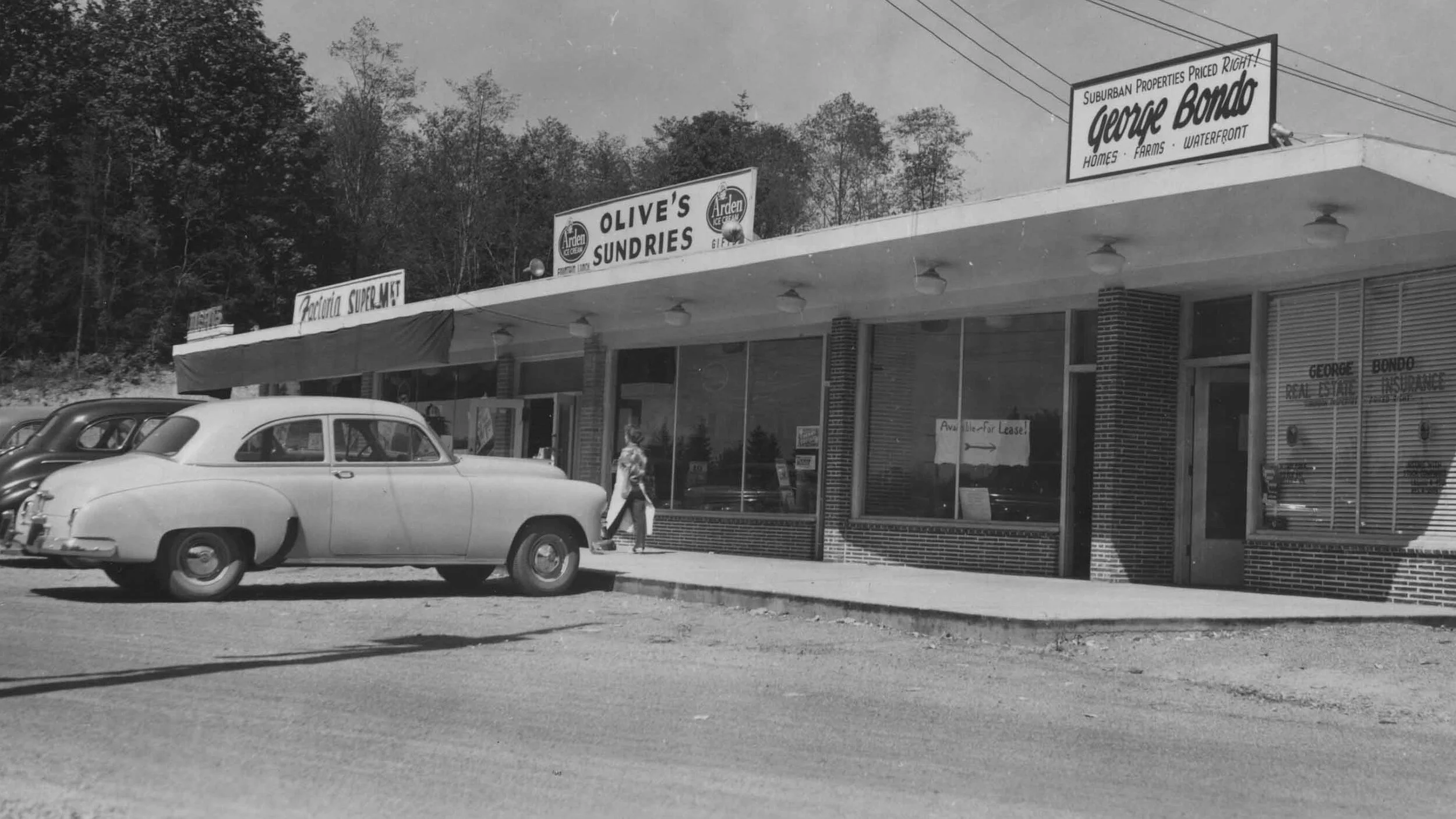
Photo (above): Three stores occupying Sunset Shopping Center Shown, Factoria Supermarket, Olive's Sundries, and George Bondo - Realty Priced Right

Photo (above): Three stores occupying Sunset Shopping Center Shown, Factoria Supermarket, Olive's Sundries, and George Bondo - Realty Priced Right

By December 1950 the Sunset Super Market was open for business, and the following year a second building went up next door, occupied by Olive’s Sundries (Olive was Henry’s older sister) and by George Bondo Real Estate.  At some point one of the walls of the grocery held a huge mural, perhaps created by “Mother Chellson,”  illustrating life on Lake Washington.   On the market’s first anniversary, Ole and Henry advertised in the Mercer Islander a free television set and groceries “to select customers.” Also in 1950 the Sunset Drive-In Theater opened, the venue for the shopping center’s “annual” Easter egg hunt in 1951 for kids under 12 years old.

In 1952 Henry was recalled to the Marines and went off to the Korean War.  The grocery was leased out, and to keep himself busy Ole built a gas station in the little complex and operated it for Richfield Oil.  Over the years more small businesses were added: a barber shop, Bob Jones Surveyor, and Petersen’s Upholstery Shop.  The market got Russ Baker’s Russell’s Meats, and Olive’s Sundries became Maxine’s Café (“a Good Place to Eat” according to local ads) and later Dotty’s Lunch. There was even an electrical service and plant nursery, owned by Nap Nolet. The drive-in theater was a favorite draw.  An Issaquah resident who grew up in Hilltop Community recalls that the local teenagers who didn’t want to spend the money for an entry ticket would drive to the hill across the Sunset Highway, near the Unitarian church, and watch the movie from there, even though they couldn’t hear it.

Photo (above): Image of shelves in the Factoria Supermarket stuffed with food. The mural designed by Mrs. Chellson can be seen on the back wall.

Photo (above): Image of shelves in the Factoria Supermarket stuffed with food. The mural designed by Mrs. Chellson can be seen on the back wall.

But the Eastside’s population was exploding, and the local subdivisions offered their own larger supermarkets and related small businesses.  In 1977 the Factoria Square Mall opened right next to and to the South of  the drive-in and the little Sunset Shopping Center.  Among the three largest stores were a Safeway, an Ernst Home Center and a Pay-n-Save drugstore.   Several other buildings held smaller shops.  In 1980 a three-theater complex opened at Factoria on the site of the old drive-in. The handwriting was on the wall.

In 1999 Henry Chellson donated to the Eastside Heritage Center a trove of family  photos and memorabilia.  Unfortunately, the outset of coronavirus has closed access to that collection, and with local libraries and archives still closed, it’s not currently possible to trace the final stages of life of the Sunset Shopping Center.  It still lives on in the memories of those current residents who grew up in the Eastside of the 1950s and 60s and for whose families the modest grocery was a godsend, a spot to pick up a quart of milk, loaf of bread, or some fresh meat on the way home from work in Seattle or shopping at Bellevue Square.

Photo (above): In this aerial photograph you can see the back of the drive-screen with the little shopping center buildings laying between the theater and highway 405.

Photo (above): In this aerial photograph you can see the back of the drive-screen with the little shopping center buildings laying between the theater and highway 405.