Kirkland Steel Mill

Kirkland Steel Mill

L 75.0545Peter Kirk’s Steel Mill, Kirkland. The Great Western Iron and Steel Works on Steel Works Lake (formerly known as Forbes Lake, now known as Lake Kirkland) c.1895

L 75.0545

Peter Kirk’s Steel Mill, Kirkland. The Great Western Iron and Steel Works on Steel Works Lake (formerly known as Forbes Lake, now known as Lake Kirkland) c.1895

According to Peter S Kirk the city that bears his name today, Kirkland, was supposed to be the Pittsburgh of the West in the 1890s.  There were abundant natural resources of iron-ore and limestone locally.  A.A. Denny and other local celebrities had discovered rich iron-ore deposits the 1880s.  The local residents were very supportive of a steel mill because of the prosperity and wealth it would bring to the newly platted town of Kirkland.  So, what happened?

Peter Kirk, from Workington in England, was experienced in iron and steel production and had access to qualified personnel to start a steel mill.  He had also toured through several steel mills in Pittsburgh prior to coming to Seattle.  He had officially incorporated the Moss Bay Iron and Steel Company of America in 1888 and secured $5,000,000 of capital.  This is about $138,000,000 dollars in 2019 dollars and was thought sufficient at the time to start a steel mill.

Sadly, there were a number of factors that conspired against Kirk and other investors to assure the mill would not be built.

First, the year 1893 saw a major downturn, or “panic” in the stock market.  East coast investors suddenly saw their money evaporate.  Kirk had the original money but it was being used up rapidly to purchase equipment for the new mill and he needed more to continue.  It is an expensive proposition to start a new steel mill from scratch.  Money and investors were evaporating in a hurry.

Second, transportation was a major issue.  The plan for the mill was to produce rails for a rapidly expanding west coast railroad building boom.  The finished rails had to be moved from the eastern shore of Lake Washington out into Puget Sound and into the Pacific Ocean.  Though a Lake Washington Ship Canal was being talked about and planned it had not yet been built.  The Montlake Cut was neither discussed nor planned at this time.  Without these two public works projects it would be very difficult and expensive to move the steel out of Lake Washington much less out of the Puget Sound area. 

Another transportation issue not yet solved was the railroad spur to be laid from the iron-ore mines near Snoqualmie to the Rose Hill steel mill site.  Given the nation’s financial woes in 1893, it was not going to get built soon.

The final hurdle to overcome was the high ash content of the nearby Newcastle coal.  High ash content coal is not good for coking coal, a key ingredient in steel manufacture.  Sadly, Peter Kirk did not have a viable backup plan to get the coking coal he needed.

It probably would have been possible to solve one of the aforementioned problems and move on with the steel mill.  However, all the problems combined proved too much to overcome and the steel mill bubble burst, for good.

By Jim - EHC Volunteer 

References/Sources

1.     Bagley, Clarence B, History of Seattle: From the Earliest Settlement to the Present Time.  Volume 2, page 632.

2.     Ely, Arlene, Our Founding Fathers: The Story of Kirkland, 1975, Published by the Kirkland Public Library, Kirkland Washington

3.     Sherrard, William Robert, The Kirkland Steel Mill.  Thesis in partial fulfillment of Master of Business Administration, University of Washington, 1958.
Eastside Stories: Logging the Eastside

No. 2 | February 20, 2019

Eastside Stories

Subscribe to Eastside Stories by emailing us at: info@eastsideheritagecenter.org

Eastside Stories is our way of sharing Eastside history through the many events, people places and interesting bits of information that we collect at the Eastside Heritage Center. We hope you enjoy these stories and share them with friends and famil…

Eastside Stories is our way of sharing Eastside history through the many events, people places and interesting bits of information that we collect at the Eastside Heritage Center. We hope you enjoy these stories and share them with friends and family.

Welcome to Eastside Stories, a new series from the Eastside Heritage Center. Through these periodic postings we will bring Eastside History to life and highlight the people, places, and events that have shaped its remarkable evolution.

Logging the Eastside

When the first intrepid settlers made their way to the Eastside in the 1860s, mostly what they found were trees. Really big trees.

As with so many things in life, this presented both a problem and an opportunity. The problem was that most settlers wanted to do what most Americans did at that time: farm. The Homestead Act of 1862 made land pretty much free for the grabbing, and as the area around the town of Seattle got carved up, settlers headed across and around Lake Washington to stake their claims and start farming. But there were those trees—up to 150 feet tall and several feet across.

The opportunity was to turn those trees into dollars.

 
A crew from the Siler Logging Co. in Redmond cut a large cedar tree. The loggers on the upper left and right are standing on spring boards.(OR/L 79.79.044)

A crew from the Siler Logging Co. in Redmond cut a large cedar tree. The loggers on the upper left and right are standing on spring boards.

(OR/L 79.79.044)

The Puget Sound area had its start as timber country. The first commercial transaction in the new metropolis of Seattle (the Denny Party huddled in a cabin on Alki Point) consisted of the sale of a load of logs to a schooner captain for use as pilings in San Francisco Bay. The rapid growth of San Francisco after the Gold Rush provided a ready market for lumber, shingles, and pilings.

Getting those enormous logs to mills and ships presented a challenge. Water was the answer, and the timber cutters made their way along the many miles of shoreline on Puget Sound, gradually working their way inland. But since Lake Washington still lacked a good connection to Puget Sound, getting Eastside logs to mills was impossible at first. So the earliest Eastside settlers clearing their farms often had no choice but to burn the logs.

 
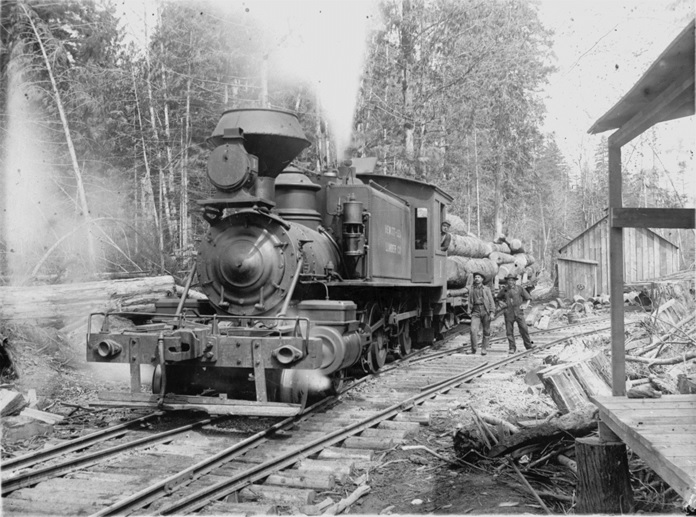
A locomotive belonging to the Hewitt and Lee logging company in Bellevue hauls a load of logs. (2002.147.004)

A locomotive belonging to the Hewitt and Lee logging company in Bellevue hauls a load of logs. (2002.147.004)

Three important changes, beginning in the 1880s, made Eastside logging profitable. First, mills began to spring up along Lake Washington, and then gradually inland. It would always make more sense to ship higher value lumber and shingles than to transport logs, so mills followed the loggers inland. A number of the largest mills were around Lake Sammamish, which was served by early rail lines.

Second, transportation improved. In 1885 a log sluice opened in Montlake, between Lake Washington and Portage Bay. This ditch had a gate at the upper end (Lake Washington was about nine feet higher than Portage Bay at that time) which was opened to let rushing water carry logs to the mills along Lake Union. Railroads began to extend across the Eastside in the 1880s, allowing easier shipping of logs and lumber.

 
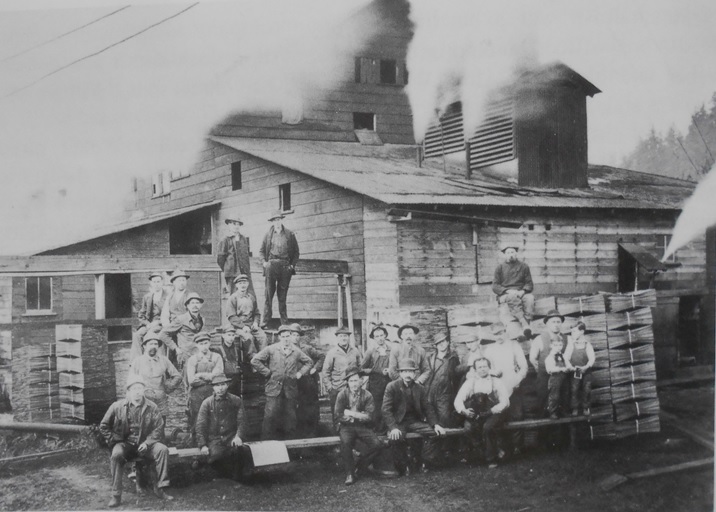
Employees at Webber's Shingle Mill on Lake Sammamish. (OR/L 79.79.049)

Employees at Webber's Shingle Mill on Lake Sammamish. (OR/L 79.79.049)

Third, mechanization began to take over. Steam powered donkey engines pulled logs from hillsides and gullies using steel cables known as “wire rope.” Hand saws and axes were replaced with mechanized harvesting equipment. Trucks replaced horses and oxen.

By the 1920s, most of the Eastside had been logged off. Remaining smaller trees that were not worth cutting for timber, and are often seen standing alone in photos of the period, were taken for pulp. As timber was cut and stumps removed, farms spread across the Eastside. Aerial photos from the 1930s show few heavily wooded areas, with most of the Eastside taken up by farms and sparse second-growth forests. 

Today, a sharp-eyed observer can see evidence of early logging. Western Red Cedar rots very slowly, and original stumps can be found in second growth forests around the Eastside. On the sides of many of these stumps, notches for springboards—platforms that allowed loggers to cut above the fat base of the tree--can still be seen. 

Looking at the mature residential areas and dense second growth forests of the Eastside, it can be hard to imagine that 100 years ago most of the Eastside was quite barren. Fortunately those big trees have a way of growing back to provide us with beauty, shade and oxygen.


Our Mission To steward Eastside history by actively collecting, preserving, and interpreting documents and artifacts, and by promoting public involvement in and appreciation of this heritage through educational programming and community outreach.

Our Vision To be the leading organization that enhances community identity through the preservation and stewardship of the Eastside’s history.


Eastside Heritage Center is supported by 4 Culture

Eastside Heritage Center is supported by 4 Culture

Strawberry Festival Update

Dear friends of the Eastside Heritage Center and the Bellevue Strawberry Festival:

With no small amount of sadness, the board of the Eastside Heritage Center has decided not to produce the Bellevue Strawberry Festival in 2019. There is some chance that an outside event producer will pick up the event in the future.

The Bellevue Strawberry Festival has been an unqualified success over the years. In many ways the Eastside Heritage Center has become a victim of that success. As the festival became bigger and more popular, we knew we needed to up our game and professionalize the production to ensure quality, safety and an overall great festival experience. These requirements began to get way out in front of our capacities as a relatively small non-profit community heritage organization.

The success of the Bellevue Strawberry Festival has been due, in large part, to the quality of the vendors, musicians, suppliers, sponsors and other partners we have been able to attract. For your support we thank you. We recognize that the event has a great deal of community and brand equity and that it may be possible to restart it in the future, as the same great festival but with a far smaller role for the Eastside Heritage Center. If anything changes, our loyal friends will be the first to know.

And one last shout-out to Heather Trescases, who built the Strawberry festival from the ground up, and to Lexi and rest of the EHC staff and volunteers who put in so much time and effort to make it a success.

Thank you again for your support, and we hope everyone can fill that weekend with another great event.

Eastside Stories: The Ferries of Lake Washington

No. 1 | February 6, 2019

Eastside Stories

Subscribe to Eastside Stories by emailing us at: info@eastsideheritagecenter.org

Eastside Stories is our way of sharing Eastside history through the many events, people places and interesting bits of information that we collect at the Eastside Heritage Center. We hope you enjoy these stories and share them with friends and famil…

Eastside Stories is our way of sharing Eastside history through the many events, people places and interesting bits of information that we collect at the Eastside Heritage Center. We hope you enjoy these stories and share them with friends and family.

Welcome to Eastside Stories, a new series from the Eastside Heritage Center. Through these periodic postings we will bring Eastside History to life and highlight the people, places and events that have shaped its remarkable evolution.

The Ferries of Lake Washington

We’ll begin our series of Eastside Stories with one of the things that made settlement of the Eastside possible: ferries on Lake Washington.

The earliest settlers got around by rowboat and canoe, but for the Eastside to grow as an agricultural area and as a commuter suburb, it would need reliable transportation to the burgeoning city of Seattle.

 
The Leschi, in her early steam sidewheel configuration. She was later converted to diesel engines with propellers. (Photo courtesy of Puget Sound Maritime)

The Leschi, in her early steam sidewheel configuration. She was later converted to diesel engines with propellers. (Photo courtesy of Puget Sound Maritime)

By the 1880s, entrepreneurs had seen enough people settling around Lake Washington to justify ferry service. The first problem was to get boats onto the lake, since the Lake Washington Ship Canal was still just a pipe dream. Some early ferries were built in yards in Seattle and Houghton. Others were dragged up the Black River, which drained the lake through Renton.

Early passenger steamers, like Acme , Dawn and Elfin needed a place to land. King County built a series of wharves around the lake, and most residents lived within easy distance of a ferry landing. And there was always the option of flagging a ferry for an unscheduled stop at a private dock.

By the early 20 th Century, Seattle was growing like crazy—from 50,000 people in 1890 to 250,000 in 1910—and all those new people needed to eat. Eastside farmers could supply produce, but loading it on and off small steamers would not do the trick. So, ferries for wagons and the growing fleet of cars and trucks began to ply the lake. The vehicle ferries Kent , Washington and Lincoln served on the Madison Park-Kirkland route beginning around 1900.

 
The Ariel operated on a route from Madison Park to Houghton, serving wharfs on Evergreen, Hunts and Yarrow Points. She was owned by the Johnson brothers and was the only steamer on the lake that stayed out of the hands of Captain Anderson. She ended…

The Ariel operated on a route from Madison Park to Houghton, serving wharfs on Evergreen, Hunts and Yarrow Points. She was owned by the Johnson brothers and was the only steamer on the lake that stayed out of the hands of Captain Anderson. She ended her days serving as student housing on Portage Bay. (Photo courtesy of Puget Sound Maritime)

The most ambitious ferry project was the Leschi, a steel-hulled ferry commissioned by the new Port of Seattle in 1912. The ship canal had still not opened, and there were no yards on the lake that could build a steel hull. So the hull was fabricated on the Duwamish, disassembled and re-assembled at Rainier Beach. The Leschi originally served Meydenbauer Bay and Medina (that's the Leschi in Meydenbauer Bay in the background of the the EHC logo) but the Meydenbauer stop was dropped in 1920. The Seattle-Medina route ran until the day before the new floating bridge opened in 1940.

Car ferry service kept going to Kirkland through World War II, mostly to get shipyard workers to Houghton. The last of the lake’s passenger steamers, the Ariel, which served the Points Communities and Houghton, retired in 1945.

The early steamers were lovely to look at, but like wooden steamboats everywhere, they often had short lifespans. Fires, exploding boilers, rot and sinking were the fate of nearly all of the lake’s small ferries. When Captain John Anderson began to buy up the ferries on the lake he brought some order to the chaos, but also took some of the fun and romance out of it. 

About once a decade we get another study of returning ferry service to Lake Washington. The economics have always been a challenge, and the slow speed limit in the ship canal makes for a long trip to Lake Union. A new service from Renton is now in the offing.

But Lake Washington is still full of passenger boats doing what those early steamers all did for extra money: sightseeing excursions on the most beautiful urban lake in America.


Our Mission To steward Eastside history by actively collecting, preserving, and interpreting documents and artifacts, and by promoting public involvement in and appreciation of this heritage through educational programming and community outreach.

Our Vision To be the leading organization that enhances community identity through the preservation and stewardship of the Eastside’s history.


Eastside Heritage Center is supported by 4 Culture

Eastside Heritage Center is supported by 4 Culture

Unlock the Past, Build the Future

2018 was a momentous year!

EHC 5-Photo Logo copy.jpg


· McDowell House Renovation: We celebrated the centennial of the McDowell House, home to our programming and administrative offices, following a four month renovation. We can now hold monthly programs on-site for the first time in over a decade. 


· 2018 Bellevue Strawberry Festival: We hosted the 15th annual Strawberry Festival to celebrate Bellevue's agricultural heritage. More than 60,000 people attended.


· Caring For Our Collection: In the final months of 2016, EHC secured a new storage facility for its archives in Bellevue, and in 2017 completed an inventory of EHC’s entire 60,000+ piece artifact collection with the assistance of two University of Washington Museology graduate students.  


· Educational Programming: Continued partnerships provide educational heritage programming for students in the Lake Washington and Bellevue School District. EHC interprets the historic 1888 Fraser Cabin at Kelsey Creek Farm, leads guided Early Bellevue Walking Tours, and at puts on our signature event the Bellevue Strawberry Festival.


· Hands-on History Programming: We partnered with the Pacific Science Center to launch a new spring and summer program series focused on the cultural uses of the Mercer Slough from the Duwamish to the present.


· Heritage Preservation: EHC, with the City of Bellevue Department of Parks and Community Services developed language to interpret the American Whaling Company’s whaling station located on Meydenbauer Bay. The whaling station and accompanying interpretation will serve as a new focal point for community engagement at the new Meydenbauer Beach Park, soon to open. 


· Heritage Online: EHC launched a new website. The website makes it easier than ever to see what events are coming up in the Eastside world of history and heritage. Our website also links to our online photo archive and other useful local history resources. You can make research requests through the website as well. 


Make your donation go twice as far!


 This year a supporter has offered to generously match the first $2000 donated to Eastside Heritage Center. 


Here are some examples of how your tax-deductible donation will provide crucial support:


$75 supports the preservation of a large 25'x10' canvas business directory that hung from the side of a large building on the road way between Kirkland and Bothell in 1937.


$120 funds the digitization of the business ledger from The Valley Hotel in Redmond that mainly served Loggers and the personal activities of the owner W.E. Sikes from 1881-1891.


$500 enables EHC to provide three free guided historic waking tour programs to the public.


$750 funds the digitization of one year of The Lake Washington Reflector, Bellevue’s first local newspaper, making it more accessible for researchers and prolonging the life of the physical items.


$1,500 supports EHC’s intern program, by funding a six month stipend for one student intern.


$20,000 allows EHC to display a never-before-seen Japanese war-time collection, which was given to EHC through the generous donation of a local Clyde Hill family.


$25,000 funds EHC’s annual collection storage cost.


Please consider making a financial contribution or annual pledge to Eastside Heritage Center this year, directly benefiting the very tangible pieces of community history that are in our care.


Sincerely,


Mike Johnson                                     Betina Finley

Board President                                 Board Vice President