Eastside Stories: The Wake Robin Lodge

Eastside Stories is our way of sharing Eastside history through the many events, people places and interesting bits of information that we collect at the Eastside Heritage Center. We hope you enjoy these stories and share them with friends and famil…

Eastside Stories is our way of sharing Eastside history through the many events, people places and interesting bits of information that we collect at the Eastside Heritage Center. We hope you enjoy these stories and share them with friends and family.

Article by: Barbara Williams

Its Sunday today, so where shall we go?

To the Wake Robin Lodge, don’t you know.

Receptions, dancing and chicken for all.

Teas and music, you’ll have a ball!


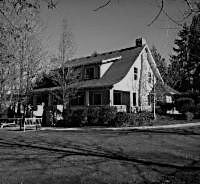
The Wake Robin Lodge was the former Enatai home of Sam Krueger. It was built around the time of the First World War (1914-1918). In 1926, Mr Krueger leased the building and the land to two African-American men from Seattle: A. Cunningham and C. James. They planned to open it as a roadhouse or restaurant. It would be the first African-American enterprise on the Eastside. They named it the Wake Robin Lodge. Wake Robin is the name of our local bird, the Spotted Towhee. It is also the South Carolina name for the Trillium flower. Both the bird and the flower are indigenous and common to this area.

The new owners remodeled the building to resemble a semi-bavarian chalet with a large stone fireplace in the main room, porches, wide front steps at the entry, inside balconies around three sides, and beautiful hardwood floors throughout the building. The Lodge was totally self-sufficient. An orchard with fruit trees framed the long driveway along which Mr. Cunningham often drove his shiny Nash car with wooden spoke wheels. There were chicken sheds, a water tank, a dairy and large vegetable garden. Almost everything that went on the tables was produced on-site. Not only that, being at the top of the hill, the building sported a lovely view to the east ..... the perfect destination for a day in the country.

When the two men opened the Lodge for business on Saturday, February 19, 1927, people were curious to sample the new restaurant. Word went out about the delicious chicken dinners, fresh vegetables and fruit, music and dancing, as well as, teas, receptions and celebrations. Visitors came flocking by ferry boat and automobile from places like Seattle and the surrounding towns to enjoy a good time. The Lodge was located just south of the junction of the paved Lake Washington Highway (Bellevue Way SE) and the Mercer Island Enatai road (108th Avenue SE) with a turn onto the long driveway (presently, SE 23rd Street). Sunday full course chicken dinners were served from 2 pm to 9 pm for $1.50 per plate. To make reservations visitors could phone: Lakeside 126. The food was delicious and the waiters, excellent. Waiters were older African American men and sometimes students from Garfield High School in Seattle. The students usually took the Leschi to Medina ferry. They worked late at night washing dishes and making five dollars a night.

Bellevue High School celebrated its 1933/1934 Junior-Senior banquet at the Wake Robin Lodge. Many celebrations happened at the Lodge including the wedding reception of Miss LaReine Renfro to Mr. Roland Putnam Burnham on June 30, 1934.

This special country inn situated just up the hill from Cecilia and Frederick Winters’s home and floral business on Bellevue Way SE, was a very popular outing for many people. However, when the Great Depression hit the country between the years of 1929 to 1933, it affected businesses such as the Wake Robin Lodge. People no longer had the money to eat out and the business began to flounder. Soon it closed. The property was then held by The Home Savings and Loan Association and the Lodge sat empty for many years. During that time, Leila Cook Martin and her sister, who grew up next door to the Lodge, loved to explore the grounds and buildings. With permission from their parents, they took their roller skates and skated around the wonderful hardwood floors. The doors were never locked and a Mr. Jones was caretaker of the white leghorn chickens. By 1941 the building was torn down. State Senator, Al Thompson bought the property. The Thompson family built a large house close to where the Lodge had stood and the land was subdivided. Today there are multiple houses in the area. The driveway is labeled SE 23rd Street and there is a sign at a loop in the road that reads “Wake Robin Farm Crescent”. So the Wake Robin Lodge and it’s people live on and with more research it’s light will become brighter and more colorful.

Photo: Aerial view showing the Winters house (light colored building on Bellevue Way SE) and the Wake Robin Lodge building (dark roof, lower left)

Photo: Aerial view showing the Winters house (light colored building on Bellevue Way SE) and the Wake Robin Lodge building (dark roof, lower left)

Resources:

Eastside Heritage Center Vertical File of newspapers and other ephemera

Book: Culinary History of a Pacific Northwest Town by Suzanne Knauss, 2007

Writings by Leila Cook Martin and her brother, Bill

Photographs:  Eastside Heritage Center data base, Barb Williams

Eastside Stories: Postal Women of the Eastside

Eastside Stories is our way of sharing Eastside history through the many events, people places and interesting bits of information that we collect at the Eastside Heritage Center. We hope you enjoy these stories and share them with friends and famil…

Eastside Stories is our way of sharing Eastside history through the many events, people places and interesting bits of information that we collect at the Eastside Heritage Center. We hope you enjoy these stories and share them with friends and family.

Article from the Eastside Heritage Center

The month of March is Women’s History Month starting in 1986 when Congress adopted the holiday from several states who were already celebrating it. 1987 marked the first year with an official, nationally recognized month honoring women. Here on the Eastside of King County we have a history of remarkable women who rose to the occasion when their family and community needed them. One of the ways was ensuring that packages and correspondence made it to residents who were often far from friends and families as they started a new life. Without email or social media, letters were the only way to get news of the loved ones and keep up with business in other regions. This article discusses some of the women who helped keep the post going since the 1880s.

Isabella Bechtel was the widow of Isaac Bechtel who moved his family from Ontario, Canada after purchasing land in Bellevue. Isabella and her six children arrived in 1885. In 1886 Isaac became the postmaster for the growing town soon to be known as Bellevue, so that correspondence could reach the residents, and importantly, the school. At the time the post office did about $100.00 in business a year.

 On November 14, 1890 Isaac was caught in a logjam near Wildwood Park and killed. The next day Isabella declared that she would take over his duties as postmaster for the region. Isabella retired as postmaster only on a disputed date sometimes between 1891-1895 probably due to the financial hardship she faced after her husband’s death. In spite of having to leave the cabin where the Bechtel home and the first post office was located, Isabella landed on her feet, moving her family to a 40 acre tract of land she bought outright. Isabella Bechtel also is sometimes credited with naming Bellevue although the origins of the name is disputed. Because her post office needed an official designation when two postal inspectors visited, they titled the location based on the beautiful view from her house.  

After Isabella Bechtel stepped down as postmaster a man named William Ivey took over. Although he held the position for 23 years, under his guidance women were still a part of delivering the post. May Johnson, a Prussian immigrant carried mail from Houghton to Bellevue twice a week. Starting at the age of 41 she carried the mail for $50 a year. May traveled the almost 4 miles armed with a can of pepper to ward off animals.

Likewise, it is said that a woman ran the first post office in Northrup.  Ann Dunn named the location herself after a pioneering family and ran the post office out of her home. In addition to her post office Northup had a school, small store, and a railway stop.

 After these first post offices and basic routes on horseback women continued to make correspondence possible on the Eastside. In 1920 Regina Blackwood became the second woman to run the Bellevue Post office.  During World War One, Donald A. Wilson recalled having to moonlight at other jobs and being assisted by Mrs. Le Huquet for 6 weeks on his route from Newport Shores to Phantom lake and then Lake Sammamish.

Adelaide Belote also assisted him in the early years of the 1900s as he made the move from Seattle to the Eastside. She became in some ways locally famous for her long stint working in the post office all the way into the 40s and 50s. Adelaide Belote served as assistant postmaster for several generations continuing the long history of women in the postal service on King County’s Eastside.

Isabella Bechtel and her two daughters , Maude to her left and Jesse to her right, stand outside of the family home and the first post office in Bellevue.

Isabella Bechtel and her two daughters , Maude to her left and Jesse to her right, stand outside of the family home and the first post office in Bellevue.

May Johnson on her horse. The photo was taken near what is now the intersection of NE 8th and 100th NE.

May Johnson on her horse. The photo was taken near what is now the intersection of NE 8th and 100th NE.

United States Post Office employees on Nov. 9, 1956. Adelaide Belote sits in the front row four from the right in a collared dress.

United States Post Office employees on Nov. 9, 1956. Adelaide Belote sits in the front row four from the right in a collared dress.

Eastside Stories: Local Coal Mining Part 1

Eastside Stories is our way of sharing Eastside history through the many events, people places and interesting bits of information that we collect at the Eastside Heritage Center. We hope you enjoy these stories and share them with friends and famil…

Eastside Stories is our way of sharing Eastside history through the many events, people places and interesting bits of information that we collect at the Eastside Heritage Center. We hope you enjoy these stories and share them with friends and family.

Article by: Steve Williams

It is hard for most of us today, to realize that coal mining was Seattle’s first major industry—centered right here on the east side of Lake Washington. Bands of coal were noted in a local stream in 1863, and that stream has been called “Coal Creek” ever since. The hills south of I-09 contain eleven different coal seams that brought skilled European miners and their families to the area. The mines brought prosperity and growth, and provided a valued export to the entire west coast. Listed below are some key points to remember:

COAL MINING – KEY POINTS

  • 100 years at Newcastle/Coal Creek. 1863-1963. (From the time of the Civil War, to construction of the space Needle and Seattle’s World Fair!)

  • Coal is carbonized plant material. (Warm swamp vegetation was covered by a rising Pacific Ocean and thousands of pounds of sand and mud from inland rivers. Over the next 35 million years, heat, pressure, and lack of oxygen converted the plants into ‘a compact rock that will burn.’)

  • There are 11 coal seams, all tilted down north at an angle of about 42 degrees. This is due to 20 million years of plate tectonics uplifting and rumpling the land, followed by mountain-building. (Mt. Rainier is only 5 million years old!)

  • Our coal is Bituminous ‘soft’ coal; 40% carbon 35% gasses. However, it made 10,000 BTUs of heat. Hotter than wood and much more compact – oil replaced coal for the same reason. (One bucket of coal was said to replace 20 stove logs).

  • Mined ‘down-slope’ 200 feet, then sideways tunnels (gangways), then up-slope, widened to rooms every other 50 feet. (Pillars were left in-between to hold the roof up.)

  • Removal by drilling & blasting with black powder, then pick ‘n shovel. (Coal rolled down to fill mine cars which were then winched up-slope to the surface.)

  • 11 million tons dug here. (Enough to fill Seahawks stadium 2 miles high!)

  • First railroad in Seattle built to get the coal. Arrived at Newcastle in 1878. (18 wooden trestles; two at May Creek 1200’ long and 138’ high!) Coal sent to San Francisco first by sail then by steamship. – Turned Seattle into a major port.

Bagley Mine Crew circa 1900. Courtesy of Newcastle Historical.

Eastside Stories: Redmond's Great Fire

Eastside Stories is our way of sharing Eastside history through the many events, people places and interesting bits of information that we collect at the Eastside Heritage Center. We hope you enjoy these stories and share them with friends and famil…

Eastside Stories is our way of sharing Eastside history through the many events, people places and interesting bits of information that we collect at the Eastside Heritage Center. We hope you enjoy these stories and share them with friends and family.

Article by: Tom Hitzroth

Frontier towns were typically constructed of wood and could be partially or totally destroyed by a fire that started from a chance spark from many different sources. No community large or small was safe from fire and Redmond was no exception.

On October 26, 1889, William E. Sikes purchased a lot from Luke McRedmond and built the first hotel in Redmond. Sikes called it the Valley Hotel. At this time Redmond was still transitioning from the settlement period in its development and it would be another decade before it took on the character of a town.

Sometime in 1904 or early 1905, Herman S. Reed purchased the property from William Sikes and in 1906 Mary Walther began remodeling the Valley Hotel. The new hotel opened for business as the Hotel Walther by May 1, 1907. On May 12, 1908 Mary Walther purchased the property from Herman S. Reed. On March 13, 1910, a fire started in the hotel. The following is a likely progression of the event based on analysis by a senior fire investigator for the Redmond Fire Department of photographs taken on that day by Winfred Wallace together with the reports from the four major Seattle newspapers.

The investigator verified the chimney was the source of the fire, and explained how the fire spread on the third floor. The first photograph below shows the fire’s progression approximately 15 to 20 minutes after it began. The burn pattern on the east end of the third floor (right in the photograph), and destruction to the window frame suggested that the fire reached an intensity that exploded the third floor window. He also determined, from the way the rafters are exposed the north side of the third floor (farthest away in the photograph) burned faster than the south side.

Once the fire had begun a bucket brigade was formed to save the adjoining property. A call for help was put out to the neighboring communities and Kirkland answered the call. The Kirkland firefighters dragged two pieces of equipment four miles to the scene. However, since Redmond was not on a water system the equipment could not be employed effectively. Unable to suppress the fire there were only a couple of alternatives left. They could let the fire burn, contain it the best they could, and hope it didn’t spread to the rest of the town, or they could try a controlled demolition to bring the fire to an end. It was decided to try a controlled demolition.

The building on the right in the second photograph, though damaged by the fire, was brought down by the controlled demolition. The investigator and I discussed the probable placement of dynamite charges that brought the hotel down. Most likely, because the building was 25 feet north of Cleveland Street, Cleveland Street was 60 feet wide, and based on the density of the surrounding buildings, collapsing the hotel toward Cleveland Street would have been the most viable and sensible option. The fire did not completely burn out until the early morning of March 14.

The destruction of the Hotel Walther in 1910 was a major calamity for Redmond particularly as it jeopardized the survival of the town. Through the skill of those unknown individuals who positioned the dynamite charges that helped contain the fire, the only other buildings lost were a small shed and a barn. The upside was that no customer lost personal belongings in the fire, the hotel furnishings were saved, and no one was injured.

Later in 1910 Mrs. Walther rebuilt the Hotel Walther on the northeast corner of Leary Way and Cleveland Street. In 1912 the property was purchased by Harry Evers and renamed it the Grand Central Hotel.

orl79-79-123.jpg
l87-011-002.jpg

Both photos top and bottom: Walther Hotel burning March 1910. Photographs by Wallace Studio.


Our Mission To steward Eastside history by actively collecting, preserving, and interpreting documents and artifacts, and by promoting public involvement in and appreciation of this heritage through educational programming and community outreach.

Our Vision To be the leading organization that enhances community identity through the preservation and stewardship of the Eastside’s history.


Eastside Stories: Factoria School

Eastside Stories is our way of sharing Eastside history through the many events, people places and interesting bits of information that we collect at the Eastside Heritage Center. We hope you enjoy these stories and share them with friends and famil…

Eastside Stories is our way of sharing Eastside history through the many events, people places and interesting bits of information that we collect at the Eastside Heritage Center. We hope you enjoy these stories and share them with friends and family.

Anyone driving around the Bellevue area these days is familiar with the sight of new school buildings rising to completely replace those built not so very long ago, in the 1950’s and 60’s when the Eastside’s population was soaring. So it’s something of a surprise to discover that here and there remnants of the truly early school buildings live on, hidden in unexpected places. 

One of those early buildings is the Factoria School, built in 1929 on the side of the hillside overlooking what is now the I-90/ I-405 interchange.  An even earlier schoolhouse, a good-sized frame building, had been built in 1901, creating tiny Factoria School District #134, which never comprised more than one school.  At that time, the east-west route where I-90 now lies was a trail connecting Mercer Landing at Enatai to Robinson Landing on Lake Sammamish People moving north and south went most easily by boat on Lake Washington.  So it is perhaps not surprising that the schools that existed in those days served just their very immediate communities of farmers, loggers, and coal miners.  In 1901 the closest school houses to Factoria were at Wilburton, Newcastle, and near Phantom Lake.

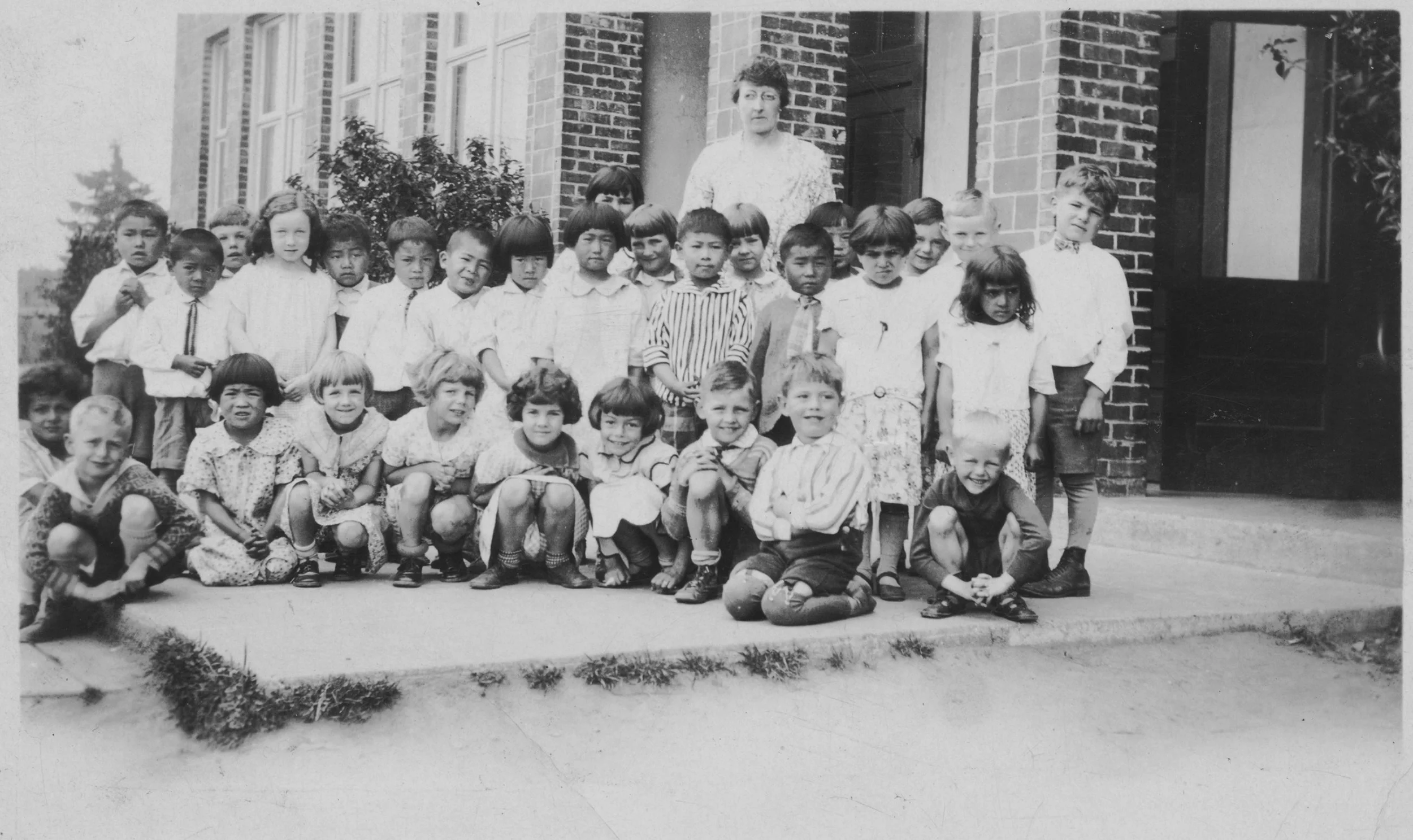
1989.05.04, photo of schoolchildren on steps of school, 1924

1989.05.04, photo of schoolchildren on steps of school, 1924

In 1929 the original school house burned down and was replaced by a brick structure containing four classrooms.  A cement lintel over the front door was incised with the school’s name.  In 1942 District #134, along with five other local districts plus Union S High School, consolidated to become Overlake School District. Wartime brought other changes as well.  Factoria School was closed and turned over to the Army for use as a barracks. It was also one of several  locations on the Eastside that received loads of sand that residents were directed to pick up and keep on hand in case anticipated  bombings caused fires.  The building was returned to the school district after the war and reopened in 1950 as part of newly created Bellevue School District #405.

2005.0280.158, building after sale in 1961

2005.0280.158, building after sale in 1961

In the early 1950’s settlement was still sparse east of what is now I-405:  Somerset, Eastgate and Lake Hills lay in the future.  Factoria’s students, first through fourth graders in four classrooms, came largely from the communities of Norwood Village, Horizon View and Hilltop plus families along Newport Wa, Richards Road, and the lake shore south to Hazelwood. They moved to Enatai School after fourth grade.  One resident who attended the school at that time recalled the year that the entire school went all in for the March of Dimes.  Kids brought in dimes that were stuck onto a long roll of adhesive tape, marked on the back with a different color for each grade. They raised $65.10 and also wrote letters to children at Children’s Orthopedic Hospital in  Seattle who were polio patients. (In those years the fear of contracting polio was very much on children’s minds.)

2013.046.086, Factoria School fire, 1960

2013.046.086, Factoria School fire, 1960

In 1957 a larger school, Woodridge Elementary, opened, and little Factoria School was dedicated to special services personnel but still served as a polling place for two precincts.   In 1960 it burned but wasn’t destroyed.  In 1961 the school district sold the building to Farwest Electronics.  The lintel inscribed “Factoria” was cut away and eventually donated to the Bellevue Historical Society.  For several years it rested beneath trees at Woodridge Elementary.  When that school was torn down and replaced with a new structure in 2008, the lintel was returned to the Eastside Heritage Center, where it now resides, safe and dry but quite unobserved, in the basement of McDowell House.

And what of the old school building?  Against all odds, it would seem, it still lives on.  S.E. 32nd St. dead ends beyond East Shore Unitarian Church in front of a contemporary looking building housing Seattle King County Realtors Association and other offices. Hidden beneath the new façade, the old brick building, now 90 years old, continues to serve a useful purpose to yet another resident on Woodridge Hill.

 By: Margaret - EHC Volunteer


Special thanks to Mary Ellen Piro for previous research into this topic. She left her notes and findings to EHC.


Our Mission To steward Eastside history by actively collecting, preserving, and interpreting documents and artifacts, and by promoting public involvement in and appreciation of this heritage through educational programming and community outreach.

Our Vision To be the leading organization that enhances community identity through the preservation and stewardship of the Eastside’s history.


4Culture.png