Eastside Stories: Remembering What the  1996 Duvall Earthquake Showed Us

Eastside Stories is our way of sharing Eastside history through the many events, people places and interesting bits of information that we collect at the Eastside Heritage Center. We hope you enjoy these stories and share them with friends and famil…

Eastside Stories is our way of sharing Eastside history through the many events, people places and interesting bits of information that we collect at the Eastside Heritage Center. We hope you enjoy these stories and share them with friends and family.

Although the Duvall earthquake that occurred in 1996 is not the largest or most devastating before or since it is an example of a geological event which forced scientists to take a closer look at what we know about the world around us. In 1932, before seismology was a formalized branch of science, an earthquake hit the same spot in Duvall. The earthquake storm that followed in 1932 lasted 6 months with residents harrowed by large quake following small quake without pattern or warning.

The more recent Duvall earthquake struck on Thursday May 2, 1996 and measured 5.3 in magnitude, the largest quake in 30 years. It was felt from Seattle to the Tri-Cities and from Vancouver BC to Portland. The quake was shallow, which would typically ensure a lot of damage but not this time. The only damage recorded by the Seattle Government was two cracked chimneys, a toppled wall, a broken pipe and several cracked foundations. This is nothing compared to the Nisqually earthquake which came 5 years later and injured over 400 people.

The Saturday after the 1996 Duvall earthquake William Steele, who at the time was the Seismology Laboratory Coordinator at the University of Washington, warned that aftershocks were possible for days and even weeks after, just like in 1932. Today William Steel is the Director of Outreach & Information Services and still helps with informing people about how earthquakes operate and what kind of impact they can and do have on the area. The 1996 Duvall quake was followed by 300 substantial aftershocks, just as Steele predicted, that reached up to 3.6 on the magnitude scale.

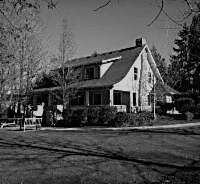
This image from 1950 showing the view from Hilltop Community was originally used in a Scheffer book. This shows the land that can be so dramatically changed by geological events.

This image from 1950 showing the view from Hilltop Community was originally used in a Scheffer book. This shows the land that can be so dramatically changed by geological events.

At the time of the quake little was known about the fault that caused it. In fact, the location of the epicenter was directly between what was believed to be two separate fault lines, the East Whidbey Island Fault and the Rattlesnake Mountain Fault. The earthquake made scientists aware of a new potential danger beneath the surface. The quake showed that the fault which caused it ran north to south. This is counter to most other fault lines in the area, that run east to west.

The earthquake kicked off new inquiries into the fault lines running under Duvall. Within 3 days scientists were out trying to determine which fault caused the quake, employing all the necessary equipment including geological maps, computer-generated relief picture, and 3-D stereograms, scientists debated what the real pattern of fault lines was on the Eastside. Demonstrating how, even an earthquake that has little impact on the people living on the surface, can cause changes in our understanding of the world.

At the time, these two faults were believed to end with a large distance between the two. The Whidbey Island Fault ending under Everett and the Rattlesnake Mountain Fault ending as far south as Northbend. This earthquake launched a debate with some claiming the two faults may even be connected. The connection between the two fault lines is still up for debate, but, because the epicenter of the quake occurred directly between the Rattlesnake Mountain Fault and the Whidbey Island Fault it was determined that at least the East Whidbey Island Fault must extend further than originally believed. This information makes us safer and more prepared. We have the geological event that occurred just two decades ago to thank for making scientists aware of this geological fault.

Either way, the Eastside remains much more geologically active than the Seattle Area making our need to be prepared for this kind of disaster vital. Although there is an awareness of the danger that this beautiful landscape conceals beneath its surface it is still unlikely that earthquakes will be predictable any time soon. That is why the Washington State enacts policies to help prepare for these kinds of disasters

Historic aerial photograph of the northern end of Lake Washington in King County this shows how in spite of an awareness of the seismic activity in the area, people continued to settle in King County even after the first recorded earthquake in the e…

Historic aerial photograph of the northern end of Lake Washington in King County this shows how in spite of an awareness of the seismic activity in the area, people continued to settle in King County even after the first recorded earthquake in the early 1800s.

Photograph from 1950 this is an aerial view of the Hilltop Community on the water front. This Photo was originally used in a Scheffer book as well.

Photograph from 1950 this is an aerial view of the Hilltop Community on the water front. This Photo was originally used in a Scheffer book as well.


Our Mission To steward Eastside history by actively collecting, preserving, and interpreting documents and artifacts, and by promoting public involvement in and appreciation of this heritage through educational programming and community outreach.

Our Vision To be the leading organization that enhances community identity through the preservation and stewardship of the Eastside’s history.


4Culture.png
CityOfBellevue.gif

Eastside Stories: The Matsuoka Family

Eastside Stories is our way of sharing Eastside history through the many events, people places and interesting bits of information that we collect at the Eastside Heritage Center. We hope you enjoy these stories and share them with friends and famil…

Eastside Stories is our way of sharing Eastside history through the many events, people places and interesting bits of information that we collect at the Eastside Heritage Center. We hope you enjoy these stories and share them with friends and family.

In the early 1900s many families left Japan and traveled across the Pacific to the United States. These immigrants settled in areas like the Eastside and became integral parts of building the cities and towns we know today. One of them was the Matsuoka Family. Leaving Kumamoto-ken, a province on one of Japan’s most southern islands, Mr. and Mrs. Matsuoka brought their two sons, Takeo (Tom) and Yoshio (John) to Washington state in 1919 after briefly living in Hawaii.

Increased immigration around the time of the Matsuoka Family’s arrival had led to the passing of the Washington State Alien Land Law , which prevented immigrants from buying land in 1921. For this reason, the Matsuoka family leased land in Kent during the 1920s and 30s, first clearing away the large stumps that had been left by the timber companies in order to farm. This extremely difficult work was remembered vividly by both Takeo and Yoshio later in their lives. To remove the stumps that littered the area and develop it into farmland, they used only horses and dynamite. They dug holes under the stumps and dynamited them to hasten their removal. Historian Asaichi Tsushima estimates that many of the stumps Japanese-Americans pulled up were 4 and 5 feet in diameter, often taking almost a whole month to remove entirely.

Once this tremendous work was complete, the Matsuoka family tended 20 acres of vegetables, sustaining themselves through the depression with farming. Yoshio recalled in a 1997 interview that the depression didn’t hit farmers as hard as others because farmers were always struggling to make ends meet. Farming led the Japanese-Americans of the Eastside to work together with their neighbors and create the Strawberry Festival in 1925 which attracted over 3,000 people across the lake. The Matsuoka family were among the many farmers who donated large quantities of strawberries and other produce to this event.

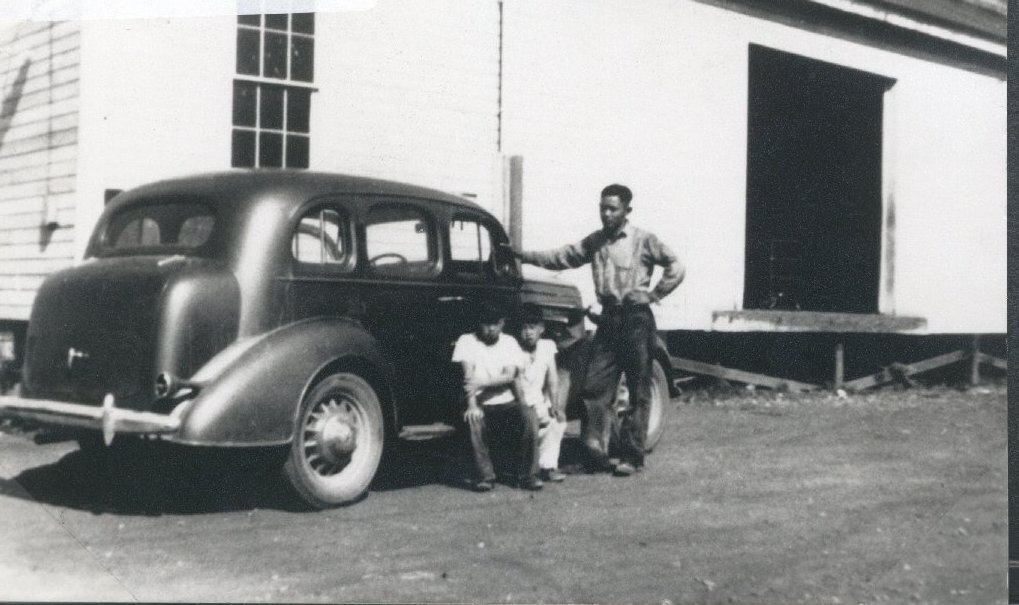
Tom Matsuoka and his sons, Ty and Tats, outside of the Bellevue Vegetable Growers Association shed, a farmer run organization which Tom helped create in the 1930s.

Tom Matsuoka and his sons, Ty and Tats, outside of the Bellevue Vegetable Growers Association shed, a farmer run organization which Tom helped create in the 1930s.

In 1927, Takeo was also a crucial organizer of the Seinenkai (Youth Club) for the young men who were growing up in Bellevue so that they would have a place to gather. He was also among the group that built the Kokaido (Club House), completed in 1930 where men came together as a community for recreation and to celebrate their cultural heritage. Buddhist worship was held at the Kokaido so that citizens of Bellevue no longer had to travel to Seattle to practice their religion.

After their father was crushed by a horse in 1932 and died of related injuries in 1937, Takeo and Yoshio found employment where they could. Both sons continued to farm throughout their lives. Yoshio worked on a farm leased by an Issei (first generation Japanese-American) in Auburn, WA. Takeo farmed land owned by his brother-in-law Tokio Hirotaka at 124th street in the Midlakes area where the Safeway warehouse complex is now located.

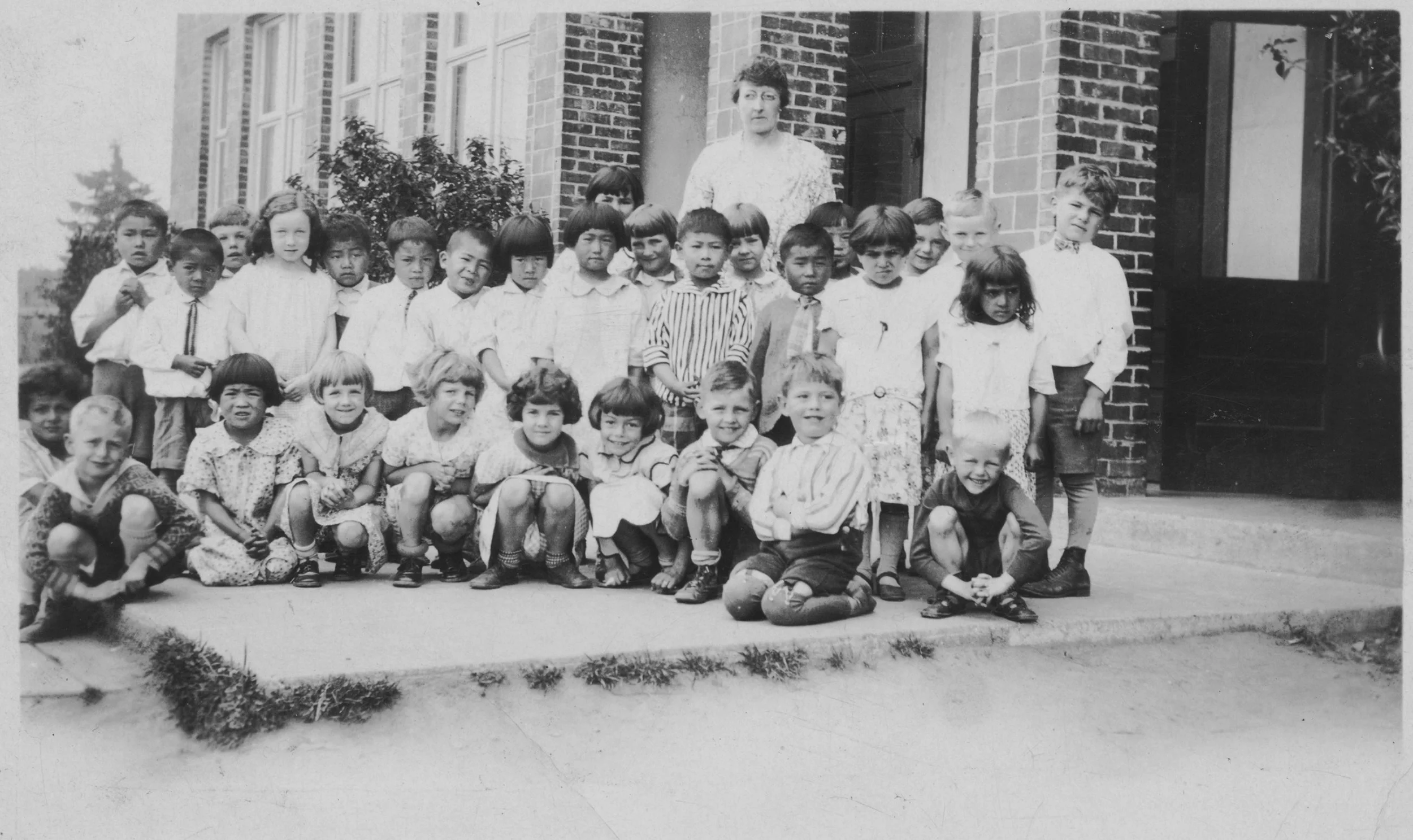
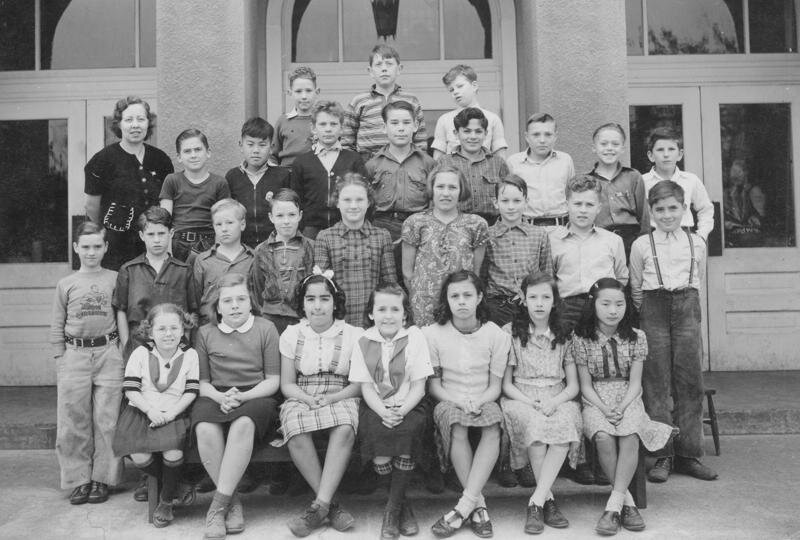
Bellevue Grade School - Fifth Grade 1940 - 1941, just before World War II and the Matsuoka Family incarceration. Takeo (Tom) Matsuoka's son, Ty, is among the students in the second row from the top.

Bellevue Grade School - Fifth Grade 1940 - 1941, just before World War II and the Matsuoka Family incarceration. Takeo (Tom) Matsuoka's son, Ty, is among the students in the second row from the top.

When the United States declared war on Japan in December 1941, Japanese-Americans were incarcerated across the nation. The Matsuoka family was taken along with all Issei and Nissei (second generation Japanese-American) citizens of King County to the Pinedale Assembly Center near Fresno, California. Overall 110,000 Japanese-Americans were taken to concentration camps across America’s Western States. Individuals were allowed only one suitcase, leaving behind their personal belongings and the farms they had worked so hard to make arable. Many lived until the end of the war with very little in prison camps. The Matsuoka family was once again saved some of this hardship by their excellent agricultural skills.

In 1942, Takeo went to the Chinook area and voluntarily worked in the beet fields in order to leave incarceration. Takeo and his wife chose to stay in Montana, returning once in 1946 and leaving again for the East. His son Ty did move back much later, in 1985.

Likewise, in 1943, Yoshio requested a transfer and was moved to Hunt, Idaho where he was required to get permission to work on a sugar beet farm. In 1944, Yoshio moved with his wife and daughter to Michigan for a work opportunity. They eventually returned to Washington towards the end of the 1940s for the birth of their second daughter.

In 1950, Yoshio leased the land which he occupied until he retired, becoming known for his ability to grow the best sweet corn on the Eastside. By 1997, Yoshio (John) Matsuoka was the last Japanese-American Farmer left in Bellevue, still working his farm and growing food. It is thanks to families like the Matsuokas that the Eastside was settled. They created the farmland which made our area a resource for Seattle and led to its future development. Theirs is just one story of many that the Eastside Heritage Center strives to preserve and share.

4 teenagers, with one adult, from Bellevue on their way to a Seattle baseball game at Columbia Playfield on the 4th of July in 1932. From left to right: Guy Matsuoka, Betty Sakaguchi, Mitsi (Shiraishi) Kawaguchi, Mrs. Kazue Matsuoka, Yuri Yamaguchi

4 teenagers, with one adult, from Bellevue on their way to a Seattle baseball game at Columbia Playfield on the 4th of July in 1932. From left to right: Guy Matsuoka, Betty Sakaguchi, Mitsi (Shiraishi) Kawaguchi, Mrs. Kazue Matsuoka, Yuri Yamaguchi

The Matsuoka Cabin was moved to Larsen Lake in 1989. At the time it belonged to the Masunage Family. This photo shows the Masunaga Family along with this historical cabin. From left to right: Yeizo Masunaga, Yeizo's wife, and Mrs. Taki Masunaga.

The Matsuoka Cabin was moved to Larsen Lake in 1989. At the time it belonged to the Masunage Family. This photo shows the Masunaga Family along with this historical cabin. From left to right: Yeizo Masunaga, Yeizo's wife, and Mrs. Taki Masunaga.


Our Mission To steward Eastside history by actively collecting, preserving, and interpreting documents and artifacts, and by promoting public involvement in and appreciation of this heritage through educational programming and community outreach.

Our Vision To be the leading organization that enhances community identity through the preservation and stewardship of the Eastside’s history.

Eastside Stories: Seattle's First Railroad and the Eastside

Article by Kent Sullivan, Steve Williams, and John Tun

Eastside Stories is our way of sharing Eastside history through the many events, people places and interesting bits of information that we collect at the Eastside Heritage Center. We hope you enjoy these stories and share them with friends and famil…

Eastside Stories is our way of sharing Eastside history through the many events, people places and interesting bits of information that we collect at the Eastside Heritage Center. We hope you enjoy these stories and share them with friends and family.

Newcastle sprung into existence in the years after Federal land surveyors discovered coal just east of Lake Washington in 1862. Seattle, a village of barely 1000 people in 1870, did not generate much demand for coal, but San Francisco, a city 150 times larger, was in great need of it for industrial and residential use, yet its local source (Mt. Diablo) was nearly exhausted. Seattle also greatly desired a “cash crop” to help provide much-needed capital. The timber and lumber businesses, although thriving on the Olympic Peninsula by 1870, were slow to develop in the Seattle area.

Creating a mining operation from scratch, to get coal to the surface, was a substantial challenge—but it was only half the battle, because the coal still had to be transported nearly 20 miles to the nearest ocean-going port, Seattle. The lowlands surrounding Seattle circa 1865 were densely-forested, old-growth wilderness, with absolutely no infrastructure (railroads, roads, settlements, etc.). Small quantities of coal were initially transported by canoe across Lake Washington, switching to small, shallow-draft barges guided south on the lake, to the Black and Duwamish Rivers, to Seattle’s waterfront, but clearly, a viable commercial enterprise could not be sustained with these methods.

Doing something different and more practical required capital—a lot of it—and there was precious little available in the village of Seattle. San Francisco, by comparison, was flush with investment dollars, and its investors were definitely motivated to help the city continue to grow and thrive. Thus, the Seattle Coal & Transportation Company (SC&T) was born in 1870.

The SC&T rapidly got an operation going that would have made Rube Goldberg proud, involving transloading coal 11 times in its journey and the first steam locomotive in the Puget Sound region.

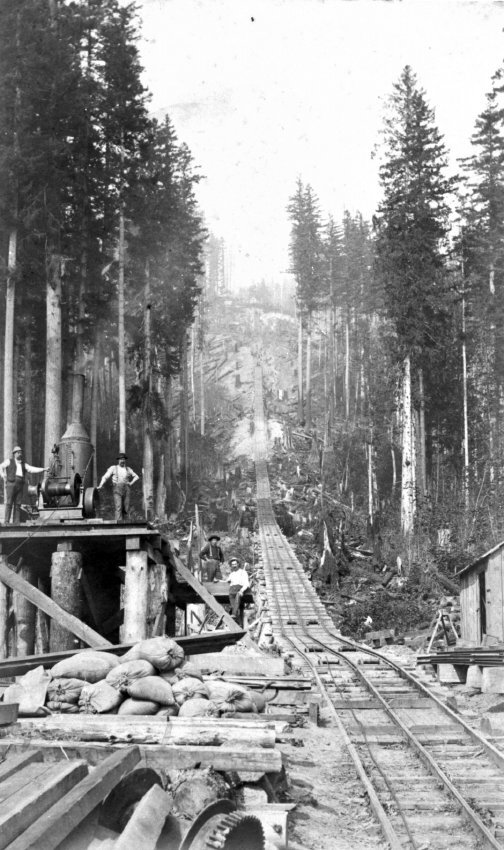
1890's coal mining in the Newcastle Hill and Bellevue area utilized rail systems to move coal.

1890's coal mining in the Newcastle Hill and Bellevue area utilized rail systems to move coal.

Amazingly, enough money was made this way that the company shut down for an entire year in mid-1873 to build a more-efficient transportation solution involving three rail segments with three separate locomotives, using a 3’ narrow-gauge system, and two lake segments, using two sets of barges propelled by two steam tugs. This system moved 500 tons of coal per day to the company’s wharf and coal bunker at the foot of Pike St., which was built by the first mayor of Seattle, was the largest structure on the Seattle waterfront in the mid-1870’s, and kept a fleet of 9 clipper ships busy transporting coal to San Francisco.

Even this system was deemed too costly and was replaced by an all-rail route in early 1878. (Please refer to Kurt Armbruster’s excellent book, Pacific Coast: Seattle’s Own Railroad for more information on this operation.) The large numbers of men (and their families) required to operate the complex mine and transportation system propelled Newcastle to become the largest settlement in the area outside of Seattle in the years before 1880.

A dedicated group of members of the Newcastle Historical Society (NHS) has been researching all aspects of the SC&T: the route, equipment, production, people, and more. Last year they uncovered the site of an incline used to lower loaded coal cars to the east shore of Lake Washington. Amazingly, part of the incline site survives today (on private property).

An information-packed presentation on many aspects of the SC&T will be given September 26 at the Bellevue Downtown Library at 7:00 PM, in conjunction with NHS and the Eastside Heritage Society. The public is invited and there is no charge. We hope you’re able to attend and learn more about this fascinating, all-but-forgotten chapter of Newcastle’s early industrial history.


Our Mission To steward Eastside history by actively collecting, preserving, and interpreting documents and artifacts, and by promoting public involvement in and appreciation of this heritage through educational programming and community outreach.

Our Vision To be the leading organization that enhances community identity through the preservation and stewardship of the Eastside’s history.

Eastside Stories: Indigenous Stories in a Land of Change

Eastside Stories is our way of sharing Eastside history through the many events, people places and interesting bits of information that we collect at the Eastside Heritage Center. We hope you enjoy these stories and share them with friends and famil…

Eastside Stories is our way of sharing Eastside history through the many events, people places and interesting bits of information that we collect at the Eastside Heritage Center. We hope you enjoy these stories and share them with friends and family.

In a place where violent acts of nature are common in the form of landslides and wildfires, and the threat of earthquakes and volcanoes are ever present, Native American stories show how these kinds of events have unending possibilities for humanity. Many Native American stories from the Eastside and surrounding areas tell of a powerful being who came and transformed the world from what it was into what it is today. Groups like the Snoqualmie and Muckleshoot peoples believe in a deity who aided people and made great changes to the earth and animals. This transformative being is known by many names including The Changer, Moon the Transformer, Xode, Snoqualmie, and Dukʷibeł. The changes and transformations brought on by these creators made the region of western Washington inhabitable for human beings and allowed crafts such as woodworking to begin.

For the Snoqualmie, Dukʷibeł (Moon the Transformer) is the son of a human girl and a star. As a baby, he was stolen away and gained magical powers which allowed him to come back and transform the world. Lake Washington and all the cities and towns around it make up the ancestral land of the Muckleshoot, Snoqualmie, Duwamish, Coast Salish, and other indigenous groups who had and maintain a deep knowledge of the environment around them through sharing skills, stories, and stories.

Snoqualmie Valley Hop Farmers and Workers, c. 1890. L88.029.003.7

Snoqualmie Valley Hop Farmers and Workers, c. 1890. L88.029.003.7

“This is the land of the Changer, the Star Child who descended from the heavens to the fertile earth and, as Moon, married a daughter of the Salmon people, ensuring his human kin happiness and plenty if they would respect the family of his bride.” The Changer pops up in other stories but his largest work was in the shaping of the land around us. It is said that he announced his plan to make the earth into a place for human beings before coming to Western Washington to do his work of creating the world as we know it today. Some animals were angered by this and deer are said to have prepared bow and arrow to fight The Changer. When The Changer came he took the arrows and stuck them into the deer’s head, making them docile and turning them into prey. Actions like this turned the earth into a place where human beings could live.

In the many stories about this transformative deity, the great changes he creates are almost always beneficial to humans as a whole or as individuals. The tribes of our area reveal their great understanding of the changes that came before humanity arrived to the geological landscape. Recently, indigenous stories have begun to gain the respect they deserve as sources of knowledge and a form of information sharing. In fact, the area of Geomythology has been gaining ground in the scientific field as stories from indigenous people around the globe prove to be records of previous geological changes. For example, the Duwamish tell of a large red sandstone boulder called ‘yahos’ that animal spirits are said to live in. These boulders indicate fault lines and areas of previous seismic violence, having been pushed up by the shifting of the earth. Fear of these rocks would have protected people from settling in areas that were prone to dangerous geological occurrences.

The story of The Changer and Moon the Transformer also teach people today about the beautiful land in Washington, west of the Rockies. By making change into a positive force and honoring the one who brings those changes, Indigenous people of Western Washington demonstrate their knowledge that even catastrophic environmental events can bring renewal and replenishment to the earth.


Sources

Beurge, David M. "Native Americans of the Pacific Northwest: An Introduction." American Indians of the Pacific Northwest Collection. Accessed August 06, 2019. https://content.lib.washington.edu/aipnw/buerge1.html

De Los Angeles, Steve. "Story of the Moon." Story of the Moon | Snoqualmie Tribe. 2012. Accessed August 06, 2019. https://www.snoqualmietribe.us/moon

Krajick, Kevin. "Tracking Myth to Geological Reality: Once Dismissed, Myths Are Winning New Attention from Geologists Who Find That They May Encode Valuable Data about Earthquakes, Volcanoes, Tsunamis, and Other Stirrings of the Earth.(News Focus)." Science310, no. 5749 (2005): 762-764.

Matthes, Whitney, Frey, Rodney, Putsche, Laura, and Tripepi, Robert. The Relationship between Plants and People: An Ethnobotanical Study in Partnership with the Muckleshoot Tribe , 2016, ProQuest Dissertations and Theses.

Watson, Kenneth Greg. "Native Americans of Puget Sound -- A Brief History of the First People and Their Cultures." Native Americans of Puget Sound -- A Brief History of the First People and Their Cultures. June 29, 1999. Accessed August 06, 2019. https://www.historylink.org/File/1506

Origins of Places’ Names in Bellevue and Its Surroundings

OR/L 79.79.244

OR/L 79.79.244

When people choose a new city to live, they usually don’t care about the name of their new city. What matters are, for example, location, transportation, or the cost of living in that city, but normally how the name of city sounds doesn’t matter.

                I am one of the unusual persons who decided to move to Bellevue partly because of its name – I felt the tone of its name “Bellevue” comfortable and beautiful. Though I confess that it wasn’t the main reason that I chose Bellevue as my first city in the United States (yes, there were lots of other reasons – of course more practical ones), the name of Bellevue was definitely a part of reasons for me.

                But why is Bellevue called Bellevue? It’s a bit strange to give such a French-influenced name only to Bellevue (as you may already know, Bellevue means “Beautiful view” in French), seeing that there seems to be no such influence on names of other places in Bellevue or surrounding areas.  This question leads me to refer to some origins of places’ names in Bellevue and surrounding areas in this article.

                In Bellevue and its environs, I think one of the most visible categories about places’ names are the ones named after persons’ names. For example, there are Larson Lake (named after Ove Peter Larson, coal miner, homesteaded in 1889), McCormick Park (named after Robert McCormick, who was active in many civic projects during the fifties and the sixties), Meydenbauer Bay (named after William Meydenbauer, one of the first pioneers in Bellevue in 1869) and Mercer Slough (named after Aaron Mercer, settled in August 1869) in Bellevue or near Bellevue. In those cases, the names were chosen either among the persons who engaged socially in the area (This is true of McCormick’s case), or among early pioneers coming to the area.

                There is a case in which a wish about future image of place can form its new name. Factoria, a business district in south Bellevue, was named in anticipation of its future industry. Fortunately, now Factoria is one of the liveliest commercial districts in the city, although it is not certain if this is thanks to its name.  

                Let’s get back to the name of Bellevue itself. I found two possible explanations why it was named Bellevue, and from both points of view, this name is something to do with the first post office in Bellevue, established in the 1880s. The first one tells that, during a conversation among postmen working there, one postman suggested to give to this area a name related to its good view, and in agreeing with him, another proposed to spell it in French way. According to this first explanation, this conversation is the origin of the name of Bellevue.  The second one tells that Lucien and Matt Sharpe, brothers who worked as first postmen in Bellevue, chose the name Bellevue for this area. Actually, their hometown was the city already named Bellevue in Indiana, and that is why they chose this name for their new place of residence. Apparently, we don’t know which one is true (or if there is another true story) because of lack of documentations, but here are two interesting explanations.

                We tend to take places’ names for granted and not rethink about their names, but exploring origins of their names is exploring their histories. If you have some time this summer, it would be interesting to take a glance at some anecdotes behind the name of the place where you live.

 By: Misako - EHC Volunteer


References:

-          Historic place names of Bellevue (Bellevue Historical society, in 1989, as a part of Centennial project)

-          “Have you ever wondered where our eastside names came from? Here’s some interesting trivia” Windermere Real Estate

-          Another version of how city came to be known by the name Bellevue, Lucile McDonald, 1980

-          City of Bellevue, About us, https://bellevuewa.gov/discover-bellevue/about-us, consulted on July 9th 2019