Eastside Stories

Quilts of the Eastside

Eastside Stories is our way of sharing Eastside history through the many events, people places and interesting bits of information that we collect at the Eastside Heritage Center. We hope you enjoy these stories and share them with friends and famil…

Eastside Stories is our way of sharing Eastside history through the many events, people places and interesting bits of information that we collect at the Eastside Heritage Center. We hope you enjoy these stories and share them with friends and family.

Eastside Stories

The Eastside Heritage Center has a large collection of quilts which date from the mid-1800s to modern day. Patchwork quilting is an American tradition used mainly by women to create useful blankets, preserve family trees and memories, and demonstrate a wide range of skills related the textile arts. A quilt is made by joining a patchwork top layer to a solid or also patched backing, although they are warmer with a cotton sheet or batting layer in the middle this is not always a part of the quilters creation as it can be expensive or hard to find at certain periods of the past.

Photo above: Detail of quilt made of hexagon patches shoeing hand stitching.

Photo above: Detail of quilt made of hexagon patches shoeing hand stitching.

Quilting is a very time-consuming task and one can imagine how much more so before sewing machines were readily available. The smaller the patches the longer the quilt would take to make with the hexagon flower pattern above. Each hexagon is only about an 1 ½ inch tall and the top layer for this is completely handsewn. It’s no wonder the quilter didn’t finish stretching and sewing this quilt to the backing. Still, this quilter’s labor is preserved in the EHC collection.

Some quilt designs are the result of fads like the Victorian era crazy quilt while many quilts are made from necessity. Quilters will often utilize any material they can find from fine ribbons and lace to worn clothes and flour sacks. Historically some companies have even catered to this by printing designs on their sacks or providing small slips of silk in cigar boxes which could then be used to make quilts. In the Eastside Heritage Center’s Collection there are quilts which still bare the logos of the mills which produced the flour backing some of the quilts.

Photo (above): Red, white, and blue patchwork quilt using the pattern known as "Job's Troubles".

Photo (above): Red, white, and blue patchwork quilt using the pattern known as "Job's Troubles".

Many quilt patterns were developed from stories in the Bible such as the quilt above showing a pattern called “Job’s Troubles”. The character Job in the Bible faced many hardships but kept his faith in God and may have been an inspiration for women who traveled west and faced many hardships themselves as they made a new life for their families. Often the creator of a pattern goes unknown. Just like today, quilters learn from each other and emulate what they see through skill. The four patches at each corner create a star and the four stars coming together create an almost circular shape. This quilter plays with the negative space by keeping all the larger patches white so together they emphasize the stars and the stars complement the shape back.  

Quilts take so long to make that sometimes quilters start them and work on them for years or set their work aside and come back to it after a long period of time. There are two quilts in our collection which were started and finished about forty years apart. We know this because the quilters themselves documented the years they worked on each.  In the back-left corner of a sunbonnet quilt, in a hard-to-read red thread over blue, white, and red flowers, are the words “Made by Georgia and Essa Smith 1938-1979”. Another quilt made by the sisters, featuring 25 stunningly hand-embroidered flower panels, reads “Made by Georgia & Essa Smith”/”Started 1930”/”Finished 1979”. Sometimes hand-stitched records like this are all we have to tell us who, what, when, and where regarding the quilts and other textiles in our collection.

Still, many things can be learned based simply on the patterns chosen, the cloth utilized, and the pictures, shapes, and stiches used to create each quilt. Quilts can be used to document communities, like one quilt in our collection showing the “5 Points Neighborhood” which existed on an intersection with five points that no longer exists. Their matching patches document the shape of the streets and show the creativity of each group who created them. Quilting can be an individual or a community activity and either way gives a unique glimpse into moments and times throughout east King County’s history. To see more patterns and learn about the history of quilts, download our new Basic Quilt Coloring Book and look out for more information on our quilt collection.
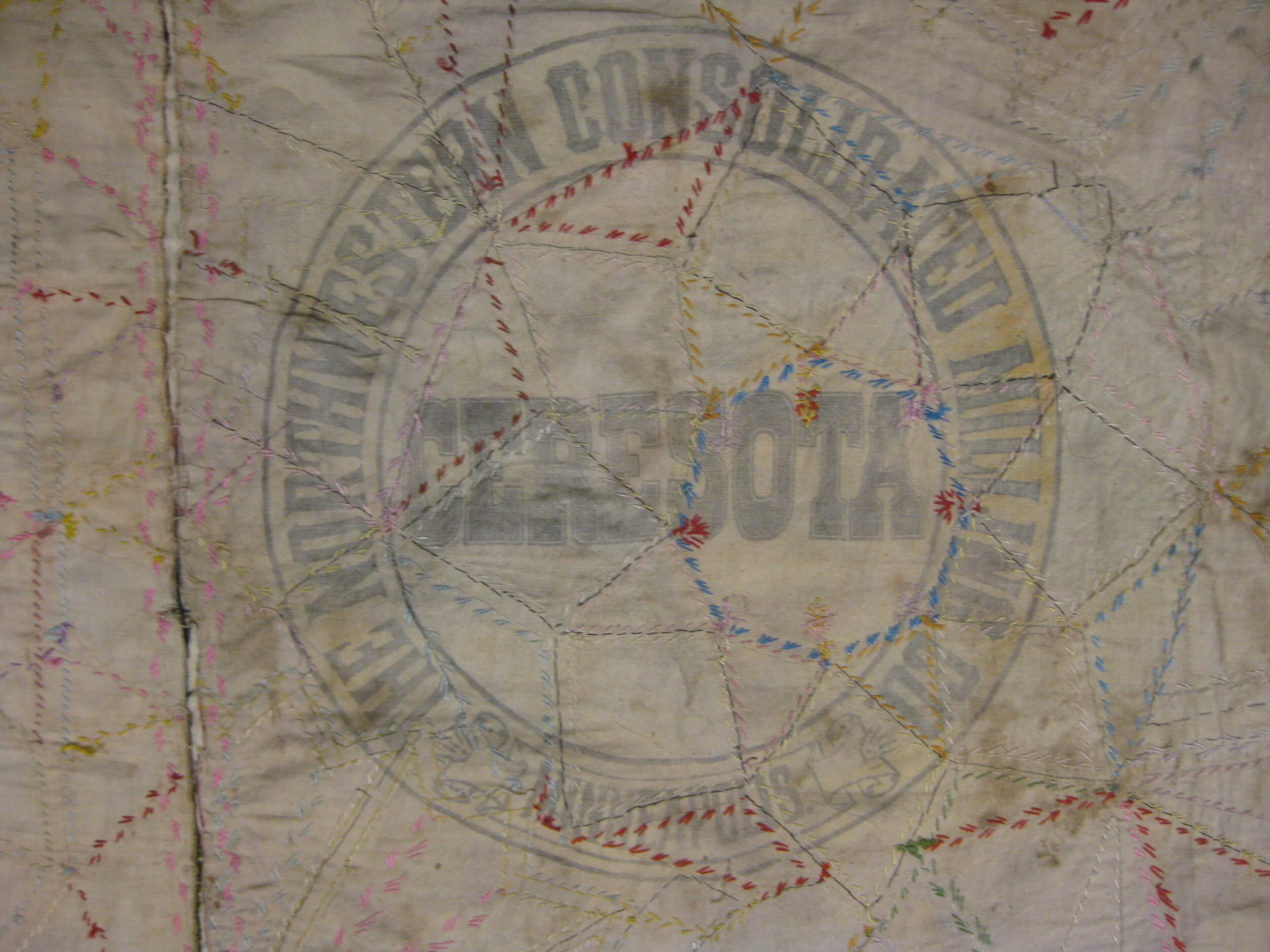
Photo (above): Quilt showing the use of printed bags from milling companies as backing for a crazy quilt.

Photo (above): Quilt showing the use of printed bags from milling companies as backing for a crazy quilt.

A History of Snoqualmie: Finding Funds for a Road by Lobbying, Taxing, and Swindling

Eastside Stories is our way of sharing Eastside history through the many events, people places and interesting bits of information that we collect at the Eastside Heritage Center. We hope you enjoy these stories and share them with friends and famil…

Eastside Stories is our way of sharing Eastside history through the many events, people places and interesting bits of information that we collect at the Eastside Heritage Center. We hope you enjoy these stories and share them with friends and family.

Eastside Stories

Much of the construction of the road through Snoqualmie Pass was driven by money. Originally a desire of local citizens, the project would eventually attract federal funding. Economic opportunities convinced private citizens early on of the need for an easily traveled road, but the US government’s reasons hinged on military defense.

As early settlers sought to attract both travelers and those hoping to set up residence, finding funds for the project was of utmost importance. The Seattle area settlers hoped to attract more people to the region and capitalize on those traveling to other parts of the west. Still, finding funds required creative thinking and patience as the project experienced several setbacks.

After Governor Steven’s two exploratory parties, The Puget Sound War of 1855 both halted construction and encouraged further exploration of the region. Although the war interrupted its construction, in the end it would be a driving force for federal funding. Major J.J.H. Van Bokkelen felt that to deter attacks from Native American groups to the east of the Seattle area on the growing population of the Seattle area a military highway was needed. He documented topographical information himself to locate strategic sites for the establishment of military encampments.

After the war military desires and a new economic opportunity further encouraged the Snoqualmie Pass project. In 1859 the Gold Rush inspired many to come west seeking fortune and the construction of a road by Snohomish county settlers across Cady pass just a little north of Stevens Pass. This is also the year that Seattle used $1,050 to appoint a superintendent of roads and started again on their project to build a road across Snoqualmie Pass. Fortunately for them soon after this Bokkelen’s ideas made it to Washington. Congress secured funds in 1860-1861 to build a road through the Cascades for military movements. They gave $75,000 for the project, but the Civil War soon interrupted the construction yet again.

Photo (above) :Snoqualmie Pass Road - planked or corduroy road through the woods. Photographed by King County Public Works.

Photo (above) :Snoqualmie Pass Road - planked or corduroy road through the woods. Photographed by King County Public Works.

Still desiring a road that would route settlers towards Seattle, in 1875 Seattle businessmen lobbied for legislature to allow them to hold a “grand lottery”. The group would sell 5-dollar tickets to raffle off Henry Yesler’s $100,000 sawmill. Unable to sell their goal of 60,000 tickets the lottery dragged on until it was declared illegal by the courts. It is thought the promoters of the lottery profited more than the road and construction remained slow.

Finally, citizens collected $2,500 to start again and construct a 25 mile road. W. W. Perkings worked from July till November with 20 men to open road. Workers labored manually and were constantly foiled by falling trees and other obstacles. Cutting brush and other debris by hand, bridges were also constructed by brute force with cedar planks. The first party that built the road with hard labor named Rattlesnake Prairie for the Camas seed pods that rattled there in the wind. They were also the first to report seeing chunks of coal in the pass which would inspire later entrepreneurs. The early work done by these 20 men would allow travel time to be cut from days to minutes as the road progressed to what it is today. From beginning to end the construction of Snoqualmie pass roads and eventually highway has been fueled by economic concerns.

Resources

Eastside Heritage Center Archives

Archaeology Around Japanese American Communities at Barnestown

Edited by David R. Carlson

Around 1898 to 1924 a small town existed in southeastern King County known as Barnestown. This town was created for sawmill and lumber workers recruited to work in the area. Building towns like this allowed workers and their families to live in a community and enjoy some comforts in between hard labor. The needs of workers and their relations is why a store, bathhouse, and school were all built. The buildings have since been taken down by the Kent Lumber Company and the lumber sold, but remnants of Barnestown’s occupants, can still be found today. The material objects left behind are clues about how Japanese Americans there spent their days and the kind of changes and pressures they faced living in a new land.

 Recently, University of Washington PhD student David R. Carlson has conducted archaeological research into the site focusing on Issei (first generation) and Nissei (second generation) Japanese Americans who lived and worked at Barnestown. By first conducting a surface survey and then excavation, Carlson and his team explored what material culture was left behind to tell about the Japanese American laborers lives and some of their experiences around adapting the life in the USA, labor relations, and racial discrimination. From documented histories about our region we know that adjusting to life in the USA was not easy for many immigrant groups, mainly because of the discrimination they often faced. For Japanese American laborers bigotry took the form of pay inequality, legal exclusion from settlement, and even outright violence. By looking at written records and the layout of the town of Barnestown, Carlson was able to create a workplan that could potentially shed light on the day to day experiences of Japanese Americans in sawmill towns like this. Carlson hopes to discover this and more about how the pressures of discrimination affected their daily lives.

Although issues such as adjusting to cultural changes and racial discrimination are not always directly evidenced in excavated material or blatantly obvious in styles of living, research into history creates an understanding of the context which typically guides archaeological research. For example, one of Carlson’s research questions is to figure out the patterns and activities related to alcohol consumption in the community. This requires him to understand what kinds of alcohol were consumed and where, and to contrast the different kinds of alcohol consumed in public versus private areas. These patterns might not seem significant, but with an understanding of existing pressures at the time, these patterns can be given more meaning. Well-documented bigotry was prevalent among many more established immigrants of European descent towards newer Japanese American immigrants. Because of this, influential members of the Japanese American community often discouraged drinking in order to help avoid dangerous situations for their fellow community members. This kind of information, can help archaeologists like Carlson imagine how certain patterns of alcohol consumption—such as a community avoiding high-proof, hard alcohol consumption—can point to larger ideas of socially acceptable alcohol consumption and racial discrimination.

This is just one example of how a more holistic view of history and material evidence can lead to important connections. The above example indicates why this is so important to put material evidence into a larger context. Archeologists rely on the physical materials and chemical evidence discovered during excavation to give clues about the reality of people’s lives in the past. Trained archaeologists have the skills not only to apply a historical context from researching paper records, they also learn to document findings during excavations in a way that tells much more than any one object could. Without this kind of information even the most interesting artifact can become useless in learning about the past. Unfortunately for this particular project, much of the analysis of physical objects had been delayed by the global Covid-19 outbreak, but David R. Carlson shared his preliminary work with us this July, and we look forward to hearing more when he is able to continue his work.

 Special thanks to University of Washington PhD. candidate David R. Carlson (pictured left) for sharing his work with us and providing the information for this article.

David R. Carlson’s research was funded by a UW Department of Anthropology Pilot Study grant and a National Science Foundation Doctoral Dissertation Improvement Grant (ID # 1743498). It was conducted with the permission and support of Seattle Public Utilities and the Cedar River Watershed Management District. This project further relies on assistance and/or material from the Cedar River Watershed Education Center, the DENSHO Encyclopedia, the Northwest Nikkei Museum, the Hoover Institution Archives, the Seattle Municipal Archives, and the University of Washington Special Collections Library, as well as a large number of incredible and dedicated volunteers! Special thanks to these organizations and Mr. Carlson for bringing this research to the Eastside Heritage Center.

A History of Snoqualmie Part 3: Conceiving the First Roads Through the Cascades

Eastside Stories is our way of sharing Eastside history through the many events, people places and interesting bits of information that we collect at the Eastside Heritage Center. We hope you enjoy these stories and share them with friends and …

Eastside Stories is our way of sharing Eastside history through the many events, people places and interesting bits of information that we collect at the Eastside Heritage Center. We hope you enjoy these stories and share them with friends and family.

Eastside Stories

The pressures which created the first road through Snoqualmie Pass hinged on the increase in population seen as the Seattle area’s population grew. Even as the project was beginning though, some maintained that it was too dangerous to travel by land. Explorers, fur traders and the eventual colonial settlers that arrived on the Eastside avoided the Cascades for a long time because of the danger posed by terrain and weather. Early arrivals traveled by water and through Oregon to avoid the formidable Cascade Range. The first road was proposed to bring more settlers quickly through the mountains.

The first route, Naches Pass to the south of Snoqualmie Pass, was one of the routes shown to European explores by Native Americans. White settlers took advantage of this indigenous knowledge as they carved out the first wagon road there. One of the first parties to cross through Naches Pass is said to have lowered its wagons by leather ropes down a 1,000-foot drop above Pyramid Creek. This party, known as the James Longmire and James Biles party, comprised over 100 people and came through the mountains short of food and bedraggled. In order to limit the hardship and endangerment of people traveling to the region, territorial leaders made building a better road a priority.

In 1853 Territorial Governor Issac Stevens was appointed by President Pierce to survey potential transcontinental railroad routes between the Great Lakes and Puget Sound. Stevens sent Captain George McClellan to find a route through the Cascades. McClellan traveled the native people’s horse route over Yakima Pass west of Lake Keechelus and just south of the pass we know today as Snoqualmie Pass. (It took a while for the newcomers to the region to figure out that the native people used two routes over the mountains. The one across what we know as Snoqualmie Pass was a foot path, the route over Yakima Pass a horse trail.) He reported that too much snow and geographic barriers made the route unusable. Not taking no for an answer, Stevens sent Lieutenant Abiel Tinkham two years later to survey a route. Tinkham set out in September with several native guides and struggled through deep snow over Yakima Pass. Not until 1856 did a party under the command of Major J. H. H. VanBokkelen successfully travel east through Snoqualmie Pass as part of an expedition to scout possible locations for forts during the so-called Indian Wars (1855-56). [article continues below]

Photo (above) :Snoqualmie Pass Wagon Road photographed in 1910.

Photo (above) :Snoqualmie Pass Wagon Road photographed in 1910.

The conflicts between colonizing groups who had settled in the Seattle area and the indigenous population had originally caused these settlers to stick close to their towns and take routes over water rather than land. It wasn’t until these conflicts escalated to include the US military in the Puget Sound War of 1855-56 that the land to the east seemed to open for European settlers.

The Puget Sound War encouraged the US federal government to look for funding to create a military highway as defense of the region proved difficult. Although a bill was passed into Congress for funding not much came of it. The Civil War interrupted Federal attempts to build a road as the focus of the nation moved elsewhere.

New laws in the 1850s and 60s encouraged people to migrate to the Puget Sound region and may have inspired the cutting of roads through the Cascades. The original wagon road was built over Snoqualmie Pass in 1868, proving a path less formidable than Naches Pass. It seems the geography of the Cascade Mountains can both help and hinder roads through the range. High peaks and sometimes uneven terrain are offset by flat bottom valleys created by Ice Age glaciers which made making a road through Snoqualmie pass much easier than it could have been.

Resources

Eastside Heritage Center Archives

“Snoqualmie Pass: From Indian Trail to Interstate” by Yvonne Prater

Cold War Defense on the Eastside Part 2: Kenmore and Bothell’s Repurposed Missile Launch Site

Eastside Stories - Check out the previous article here

Eastside Stories is our way of sharing Eastside history through the many events, people places and interesting bits of information that we collect at the Eastside Heritage Center. We hope you enjoy these stories and share them with friends and …

Eastside Stories is our way of sharing Eastside history through the many events, people places and interesting bits of information that we collect at the Eastside Heritage Center. We hope you enjoy these stories and share them with friends and family.

The last Cold War Defense article discussed one of eleven bases established to house and launch missiles on the eastside. Bases like the one that existed in Redmond were designed for defense against attacks from Soviet aircraft and warheads. These missiles were a part of the Nike Project which designed state-of-the art warheads to stop enemy aircraft, eliminate missiles, and lead us to victory. Although the Redmond base was abandoned and soon became a place for urban explorers, ghost stories, and nefarious activities another near-by base remains active today, in a way, continuing to aid in national safety. This base was known as S-03.

The S-03 base located nearly between Kenmore and Bothell at 130 228th SW Street is still active as the Federal Emergency Management Agency (FEMA) headquarters of the Pacific Northwest. The unassuming group of one-story buildings masks a large underground complex, although it is hard to say what was built for the Nike Missile Defense System and what has been added since then. Missile launch systems have been removed from the surface, but the space occupied remains the same. S-03 had a control center as well where administrative work and missile guidance took place. This space did not continue to be used by the government though. The control and administrative center of the Kenmore/Bothell base is now Horizon View Park, located on 47th Avenue. All of the original buildings and structures have been removed so nothing of the original Nike control site remains.

Opening in 1956 and closing its doors in 1964, the base had a short lifespan which doesn’t quite line up with any one major political event making the reason for its short existence up for debate. Opening before Sputnik makes it unlikely, that this advance triggered the base’s creation. Sputnik is the Russian word for satellite and also, the common name given the first satellite ever, launched by the USSR in 1957. Sputnik caused panic and anxiety as Westerners feared that the USSR had surpassed them in technological advancement and some even believed that the satellite would allow for attacks or surveillance across the globe. Of course, neither of these scenarios ended up being true and the satellite only remained aloft for about three weeks.

The S-03 site had eight missile launchers located at the facility, where they existed on the surface is now used by FEMA, replaced by more relevant structures and equipment. There were eleven sites like this across the Puget Sound area, but eight bases were chosen not to be converted to the from Zeus style missiles to Hercules Nike Missiles which may explain the closing of the site. Quick development of superior missiles meant that technology was always changing but where there was money to develop there may not have been money to upgrade existing sites. Either way, the Seattle Area Defense system, designed to protect financial, industrial, and transportation centers of the American Northwest was built and done away with fairly quickly overall due to changes in the political climate.

Within a few years of their opening the USA and USSR were already aware that de-escalation was necessary if each county wanted to have an economy that wasn’t fully war-based. The S-03 Nike Missile Base shut down before official talks known as the Strategic Arms Limitations Talks (SALT) were proposed by the United States in 1966, let alone begun in 1969. These talks were successful overtime, with the Anti-Ballistic Missile Treaty (ABM Treaty) being signed by Richard Nixon and Leonid Brezhnev in May 1972. By this time though, most of the Nike Missile Bases had already been decommissioned including S-03.

The Cold War was a time when people’s fears and anxieties got the best of them and often escalated situations like nuclear production without cause. The Seattle Area Defense System may have been a part of this or, its anti-ballistic missiles were said to be the only thing stopping an imminent attack. In the end the USA and the USSR both produced enough nuclear warheads to destroy the world many times over. Most of the sites, like the Kenmore/Bothell site at S-03, were short lived and constructed to last for less than a decade. At least S-03 found a new life as a center for FEMA, giving us a different kind of safety net, and perhaps one more useful in a place with the highest concentration of active volcanoes in the USA. The FEMA headquarters here is prepared to react to volcanoes, earthquakes, and other man-made or natural disasters which seem much more imminent than a Soviet attack on American soil ever was.

Resources

Eastside Heritage Center Archives

https://www.atlasobscura.com/places/nike-nuclear-missile-site-s1314

http://warbirdsnews.com/warbird-articles/abandoned-nike-missile-bases-united-states.html

https://www.historylink.org/File/9711

http://choosewashingtonstate.com/research-resources/about-washington/brief-state-history/

http://ed-thelen.org/MMTravis.html

https://www.nwnews.com/news/bothell-s-nike-hill-home-to-regional-fema-headquarters/article_bdc1b216-7eb5-534e-857a-987eab0976f4.html

https://www.californiademocrat.com/news/news/story/2020/aug/24/army-veteran-recognized-thwarting-threat-against-president-nixon/838731/

https://www.britannica.com/technology/Nike-missile

https://www.britannica.com/event/Anti-Ballistic-Missile-Treaty