Larsen Lake Cabin

The next of our five Bellevue cabins is located at the Larsen Lake Blueberry Farm off SE 8th and 148th SE. It was also relocated in 1990 from its original location near Phantom Lake and today serves as a trailhead and link to the Bellevue’s Lake to Lake trail system.

2002.135.01 - Possibly the Larsen Lake Blueberry Farm, circa 1930.

In March 1886, German immigrant, Henry Thode, purchased two tracts of land near Phantom Lake and built a house in 1894.  It was a two-story nine room log house made with hand-hewn logs and shingled on the outside.  Henry and his wife Emilia intended to farm, raise cattle and sell milk to the coal workers at Newcastle.  However, Henry was declared insane later that year and committed to a mental institution. 

He died two years later and Emilia remarried Jacob Kamber.  They continued to live in the Phantom Lake House.

In 1932, Shigeo Masunaga and his wife, Taki, leased the Thode House and farmed ten acres.  The family was forced to leave in April 1942 and were incarcerated at Pinedale, California.  They did not return to Bellevue.

After the war, John Matsuoka leased the Phantom Lake land from Mondo Desimone who now owned the land.  John farmed about 40 acres of the property growing fruit and vegetables. The Matsuoka’s lived in the house until 1966.  The dwellings were abandoned after John and his family moved.
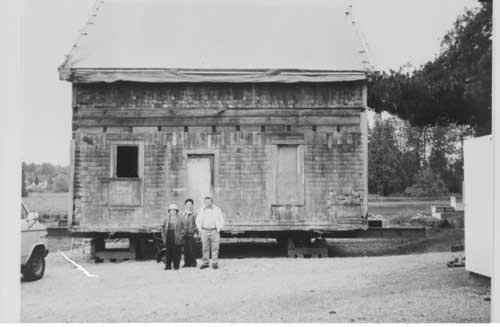
2013.050.001 - House being moved in 1989. Yeizo Masunaga, Yeizo's wife, and Mrs. Taki Masunaga at left.

In 1989, the Danieli family donated the site of the Thode Cabin to the city of Bellevue and moved it to Larsen Lake in 1990.  Renovations were undertaken to preserve and highlight the original construction methods and integrity of the cabin.  A foundation, flooring, stairway, roof, and porch were all replaced.  The shingles were also removed showing the original log walls.

If you are walking around Larsen Lake and the Lake Hills Greenbelt, do stop and check out the “Thode House”. This is an easy cabin to visit even though the inside is not open to the public.  A porch with a swing is located at the front of the house and a seasonal farm stand next door.  At the cabin enjoy the swing and take a look at the hand-hewn logs (Fraser Cabin’s logs were machine hewed).

 Resources:

“The Bellevue Story” Connie Squires, 1967

“Bellevue: It’s First 100 Year” Lucile McDonald, 1984

Asachi Tsuchima, 1952, “Pre-WWII History of Japanese Pioneers in the Clearing and Development of Land in Bellevue”

 

The Island Belle Story

BY margaret Laliberte, EASTSIDE HERITAGE CENTER VOLUNTEER

We don’t think of western Washington as prime grape-growing country today.  But during Bellevue’s early years as a farming community, seven different families grew grapes between about 1912 and the 1940s.  The Kelfner farm was located at the intersection of today’s SE 8th St and 108th Ave. N.E., near where Surrey Downs Park now stands.  North of it, R.T. Reid’s farm lay where the new light-rail station at 1112th and Main Street is nearing completion.  On the north side of the community, between today’s Bellevue Way and 100th Ave. N.E., the eastern slope of Clyde Hill was covered with vineyards owned over the years by the Clarke, Loughran, Hennig, Simpson and Borg families. Some of the farmers sold the grapes fresh, others made grape juice, and Borg’s Summit Winery sold wine, once Prohibition ended.

Photos from the time and ads in local newspapers touted the sale of “Island Belle” grapes, suggesting that they were special in some way unknown to us today. And in fact, they were.  Island Belle was Puget Sound’s very own grape variety.

2002.147.008 - Kelfner produce stand with sign announcing Island Belle grapes for sale.

The Island Belle story begins on little Stretch Island in Case Inlet on the western shore of southern Puget Sound.  In 1890 Lambert Evans settled there and began experimenting with grape cultivation.  He was joined on the island in 1899 by Adam Eckert, a New York grower, who developed a variety by crossing the Concord grape with a native North American grape.  Named Island Belle after Eckert’s elder daughter, the belle of a ball held on the island, the variety does well in the Puget Sound climate.  Very hardy, it withstands Fall frosts and can be harvested into December. It’s a versatile variety, making delicious juice and jelly.  Stretch Island eventually became the center of what was hopefully known as “Puget Sound’s grape belt,” including Harstine Island and the lands along Pickering Passage.  In 1918 the Island Belle Grape Growers’ Union was founded to market the area’s grapes in what was hoped to be, according to an article in Olympia’s Washington Standard newspaper, “a new Puget Sound industry.”  Island Belle became the most widely grown grape variety in Puget Sound country. The record harvest in 1920 returned $1,000 per acre (over $13,700 in today’s dollars). In 1928 California’s Oakland Tribune paper ran the story that Grace Mason had been crowned Miss Island Belle at the Island Belle Grape Grower’s celebration in faraway Shelton.  By 1930 Stretch Island supported two grape juice plants, owned by Eckert and a Charles Somers, who had bought the Evans property in 1918.

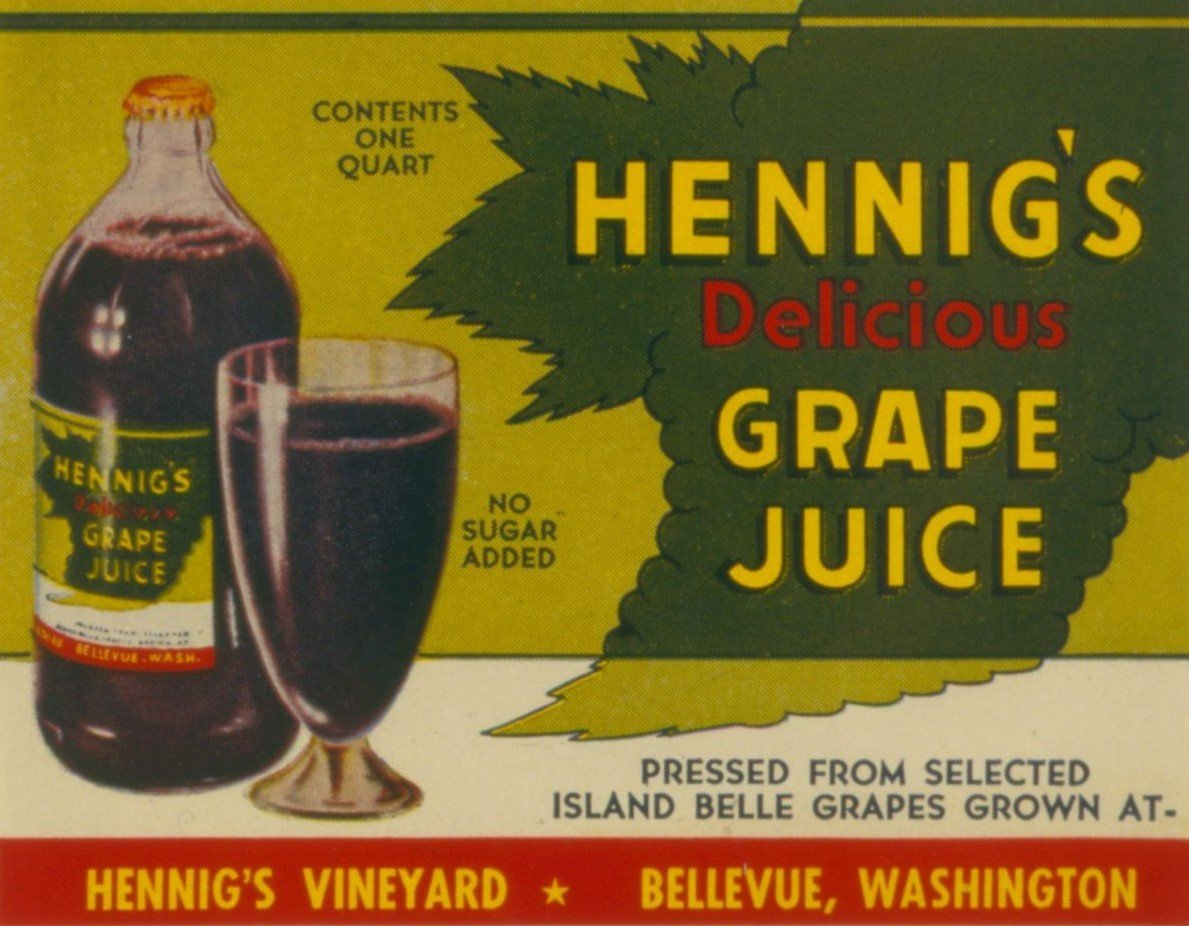
So it’s not surprising that Bellevue’s grape growers grew Island Belle grapes as well, although the harvest here typically began two weeks later than further to the south, where the climate was slightly more moderate.  John Kelfner bought his initial stock from a grower on Vashon Island and propagated his vines on his farm. When John Clarke began farming below Clyde Hill in 1919, he planted Island Belle and eventually opened Bellevue’s first grape juice plant.  (He later sold his land to the Hennig and Loughran families.)

2013.046.101 - Hennig grape juice ad.

The Depression years caused western Washington’s grape industry to crater, and it never fully recovered, although Robert Borg continued to grow his Island Belles on Clyde Hill into the 1940s.  A small remnant of the story remains alive today.  In 1978  Dick and Peggy Patterson founded their Hoodsport Winery on Hood Canal, the 16th winery to be licensed in the state.  They bought up virtually the entire harvest of Island Belle grapes from the Stretch Island vineyards, for which there was virtually no market at the time.  Over the years they expanded to create wines from other grapes as well.   In 1994 the U.S. Bureau of Alcohol, Tobacco and Firearms announced it would drop Island Belle from its approved list of wine grape names and rename the grape the “Early Campbell.” But the Island Belle is tenacious. Hoodsport Winery is still in business, and among the offerings of varietal wines on its website is “Island Belle,” “a red wine bursting with flavors of fresh raspberries and cherries. A perfect wine for picnics and barbecues.”

2011.025.003 - Vineyard on the Loughran property in Bellevue, circa 1930.


Resources

Knauss, Suzanne, Culinary History of a Pacific Northwest Town, Eastside Heritage Center, 2007

McConaghy, Lorraine, ed., , Lucile McDonald’s Eastside Notebook, Marymoor Museum, 1993

Nick Rousso, Grape Farming in Washington, HistoryLink Essay #21302

Jack Swanson,   Puget Sound: Island Belle grape on endangered list, Kitsap Sun, April 19, 1994, https://products.kitsapsun.com/archive/1994/04-19/292256_puget_sound__island_belle_grape.html (retrieved October 18, 2021

Richard Bell, Island Belle Story, activerain.com/blogsview/790969/the-island-belle-story (retrieved October 18, 2021)

Younger’s Mints

2002.125.008 - Youngers Mint recipe signed by Charlie Younger, 1929.

Mints

8 pounds Sugar

1 teaspoon Salt

1 ounce Syrup

2 ½ pints Boiling Water

When candy starts boiling, put in 1 ounce Butter. When cooks to 240° put in 2 ounces more.

Cook to 268° in cold weather and about 274° in hot weather.

Pour on slab and cool - pull & cut. Flavor 1 teaspoon vanilla and 1 teaspoon mint oil or less mint if too strong.


Too much butter in the Younger family taffy recipe resulted in the famous "melt in your mouth" Younger's mints. Started as a small operation in the basement of the Younger home in 1926, the business soon grew to the point where it was necessary to open a retail store in the original McKee building on Main Street. Not long afterwards the store moved to a building on 104th Avenue equipped with a kitchen for making the candy. In search of a better retail location, the business moved to Kirkland in 1938, as it was a larger town at that time. The candy was again made in the Younger home. In the meantime the candies were being shipped all over the world and a local reputation had been established. With the rationing of sugar during World War II the business was sold to the Anderson family in 1947.

2002.125.004 - Addie Hurley behind counter in Charley Younger's Candy Shop, Kirkland. Circa 1942.


Resources

Culinary History of a Pacific Northwest Town: Bellevue, Washington by Suzanne Knauss.

Eastside Heritage Center Archives

The Campbell Lumber Mill

By Steve Williams, EASTSIDE HERITAGE CENTER VOLUNTEER

One hundred and sixteen years ago in 1905, a huge lumber mill began operations at the northeast corner of Lake Sammamish in Washington State. James Campbell and L.B. Stedman invested $100,000 (over 30 million in today's dollars) and logged a major portion of the land east of the lake during the next two decades. They built an entire company town at Adelaide to support the mill; including a store, hotel, blacksmith shop, tool house, foreman family home and bunkhouses for 50 men.

Key to the whole operation was the Lake Shore and Eastern Railroad which ran along the shoreline between the mill and town. It had been been built by Daniel Gillman in 1889 and provided direct shipment to Seattle and other northwest destinations. Seattle expanded from a population of 3,533 in 1880 to 237,194  in 1910, and all those people needed housing. Because the railroad was there first, most of the mill was actually built on pilings extending out over Lake Sammamish.

OR/L 79.79.145 - Campbell Mill, Lake Sammamish, 1905.

The lumber company had three locomotives of its own and laid 16 miles of track across the virgin timber lands east of Redmond and Lake Sammamish. Bunkhouses for the lumberjacks were built on rail car frames and could be hauled into the woods to the end of spur lines where the trees were being cut. The logs were hauled back to the mill location, also called Campton, and were dumped in the lake for storage until they could be milled into lumber. The water washed off dirt and rocks, and prevented drying out – all of which was better for the saw blades. “Ponding” also allowed the logs to be easily sorted and moved about, and that resulted in pilings and large log booms at the north end of the lake. Old timers said that “There were so many logs that you could practically walk from one side of the lake to the other on them.”

OR/L 79.79.061 - Weber's Tug Boat, "Daisy."

The Campbell Mill operated for nineteen years, but was lost to fire in 1924 when the firemen discovered that their unused hoses had rotted and were full of holes. Many early mills and houses suffered the same fate as embers from wood-burning stoves and steam engines dropped onto wood-shinged roofs. The Lake Sammamish Shingle Mill was also located on the east shore, just south at Weber Point, and The Monohon Mill was further south towards the end of the lake near Issaquah. Beginning in the 1880's, Redmond had at least 12 different mills, but the big time logging was nearly done by 1930.  Within 50 years most of the old growth prime timber had been cut and the land was ready for stump-pulling, row-farming and dairy herds.

Today, if you go boating at the north end of Lake Sammamish you can discover rows of pilings that once supported the mill or held the log booms in place. Now, those pilings make a great protective nursery for young fish, and a hangout for all sorts of ducks and other wildlife. You can also join the Mountains to Sound Greenway in planting conifer seedlings to do your part in restoring a bit of northwest forest. Our forests help limit climate change by storing carbon, reducing flooding, evaporation and lowering temperatures. The extraction economy of a century ago is being replaced by a restoration economy of carbon credits and tree planting today.


Resources

“Our Town Redmond” by Nancy Way, Marymoor Museum, Redmond, Washington 1989.

“Index of Lumber Businesses & Mills” by Eric Erickson, Issaquah Historical Society 2003.

“Alaska Yukon Pacific Exposition”by Shauna & Brennan O'Reilly, Arcadia Publishing 2009.

“Seattle in the 1880's” by David Buerge, The Historical Society of Seattle and King County, 1986.

Redmond Historical Society website - www.redmondhistoricalsociety.org 2021.

Photos from Eastside Heritage Center collection

Fraser Cabin

The city of Bellevue is fortunate to have five historic cabins, all located in Bellevue City Parks. They were built between the 1880s and the 1890s:  Fraser Cabin at Kelsey Creek Park; Hans Miller Cabin at Robinswood Park; Sharp Cabin at the Bellevue Botanical Garden; Thode Cabin at Larsen Lake; and the Burrows Cabin at Chism Beach Park. Only the Fraser Cabin is open for viewing.

The Fraser cabin was originally built in 1888 by two Norwegian loggers who were known for their ability to build log bridges across a ravine in one day. The 16 ft. x 16 ft. cabin was located near the present day Northup Way and 124th St. about a ½ mile from the Fraser’s home. It was built for Daniel Fraser’s sister-in-law, Fanny, and her new husband Steven Rathbun. The newlyweds lived there about a year before moving to Massachusetts. 

2014.005.009 - Crowd gathered outside of the Fraser Cabin, Boy Scouts flag on flagpole. Undated.

When the Fraser’s main house was destroyed by fire in 1890, the cabin was moved to the homesite and later converted to a horse barn. In 1947, Daniel’s son, Don, moved the cabin to the corner of 126th NE and NE 7th. The logs were taken down and numbered as to assure accurate reassembly.

Eventually, Brooks Johnston purchased the property and used the former cabin as a horse barn. Johnston donated the cabin to the King County Parks Department in 1966, but there was a lack of funding for moving it to Marymoor Park. In 1974, Siegfried Semrau, Director of Parks and Recreation for the City of Bellevue Parks Department, accepted the cabin and it was moved to Kelsey Creek Park. Thanks to many generous donors, the cabin was reassembled with new walls, floor, roof, door, and windows and in May of 1975, the City of Bellevue held a Bicentennial Community Designation ceremony at Kelsey Creek.

L 88.064.007 - Siegfried Semrau, Verna Schembrie, Brooks Johnston with the refurbished Fraser Cabin at Kelsey Creek Park. Circa 1974.

Because of flood mitigation, the cabin was moved again in 2008 to its present location just south of the barns. Thanks to some creative engineering, the entire structure was moved up the hill and placed on a new foundation. A new ramp was built to make it more accessible to all.

Eastside Heritage Center opens the cabin during major events: Sheep Shearing and the Farm Fair. It is also open to the public one Saturday a month from May through September.

Resources

Eastside Heritage Center Archives