Eastside Stories: The Homestead as an ATM

No. 9 | May 29, 2019

Eastside Stories

The Homestead as an ATM

Eastside Stories is our way of sharing Eastside history through the many events, people places and interesting bits of information that we collect at the Eastside Heritage Center. We hope you enjoy these stories and share them with friends and famil…

Eastside Stories is our way of sharing Eastside history through the many events, people places and interesting bits of information that we collect at the Eastside Heritage Center. We hope you enjoy these stories and share them with friends and family.

The pioneers who built the Eastside were all diligent, sober-minded souls dedicated only to creating wonderful communities for their families and for future generations. Right? Well, most were, but for this edition of Eastside Stories we have a tale of an enterprising pioneer of a different sort.

Robert Gerrish, a board member and volunteer at the Bothell Historical Museum, has traced the machinations of a slick operator who also happens to be his grandmother’s first husband. The story—it gets a bit convoluted, but stay with it—goes like this:

Henry Rosenburg was baptized Wilhelm Henrich Rosenburg in 1852. In various documents he lists his birthplace as Stuttgart, Alsace-Lorraine and Paris. He arrived in the United States in 1876, and by 1883 he was in Deadwood, South Dakota (of course!). There he met Christina Reagan, (Robert’s grandmother) and in April of 1883 they were married in St. Patrick’s church in nearby Lead, South Dakota. In 1884, Christina and Henry, along with Thomas Reagan, Christina’s father, migrated to Seattle.

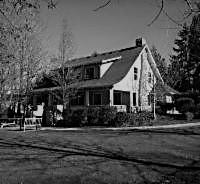
In 1885 Henry and Christina bought a house in Seattle and had their first child, Agnes. In 1886, Henry applied for Naturalization. That year he also claimed a homestead outside Bothell. Henry and Christina soon sold their Seattle house to Christina’s brother and moved in with Christina’s parents before settling into the Bothell homestead in 1888. They had had two more children, Martin and John, and all seemed well by 1889.

Henry and Christina Rosenburg in Deadwood, SD, prior to their move to Seattle in 1884. (Photo courtesy of Robert Gerrish)

Henry and Christina Rosenburg in Deadwood, SD, prior to their move to Seattle in 1884. (Photo courtesy of Robert Gerrish)

Within a few years, Henry needed capital, and in January of 1892 he took out a $500 mortgage on his homestead (about $15,000 today). Only problem was that he still did not have full title to the homestead, which he would not get until April of that year.

Five quiet years passed until January 4 th of 1897, which was a busy day for Henry. He paid off the 1892 mortgage and immediately took out a new mortgage for $142. He used $100 of the proceeds to purchase Christina’s share of the property. Christina is now listed on the deed as “Christina Rosenburg of Seattle, Washington, former wife of William Henry Rosenburg.” After the purchase was complete, Henry, now described as a “single man,” took out a second mortgage for $65. He paid off this latest mortgage in 1898, but took out yet another mortgage of $275 in 1901.

Then he disappears until 1904. Family legend was that he had run off to the Klondike Gold Rush in 1897 and never returned. But that legend appears to have been a spin to cover up the scandal of divorce in a Catholic family. Henry did venture to the Yukon, but not in 1897. He turns up in Whitehorse in 1903, where, true to form, he filed for a mining patent for 160 acres.

By 1904 Henry was back wheeling and dealing in Bothell. He took out a mortgage from the wonderfully named J.W. Nipple for $1,000 and paid off his 1901 mortgage. He paid off Mr. Nipple in 1905 and sold “All of the timber of whatsoever kind or nature standing or fallen” on his property to Woodinville Lumber Company for $2,700.

The Rosenburg family circa 1896. From left, Martin (b. 1886), Henry, Agnes (b.1885, d. 1899), John (b. 1889), Christina. (Photo courtesy of Robert Gerrish)

The Rosenburg family circa 1896. From left, Martin (b. 1886), Henry, Agnes (b.1885, d. 1899), John (b. 1889), Christina. (Photo courtesy of Robert Gerrish)

Henry would not let his Bothell homestead be debt free for long, and on February 10 th 1908, he took out a $500 mortgage on it and, ten days later, started selling it off in chunks to a buyer who paid for it one piece at a time. A month later he paid off the most recent mortgage and assigned his remaining interests to a Seattle attorney. The saga of the Bothell homestead that he had treated as an ATM, was over.

By 1908 it appears that Henry had decamped again, this time for Soap Lake, in Central Washington, where he was still listed as a bachelor. In 1915 he married again, and passed away in 1927.

In addition to the multiple mysteries of this story (why lie about his birthplace? Why a divorce when such practice was strictly prohibited for Catholics? Where did he get the money to pay all those mortgages, and, for that matter, what did he do with the money he borrowed?) is the curious way in which Henry was able to find people to lend him money on a property of dubious value (it was quite remote for that time) for perhaps unknown purposes.

During the run-up in property values and debt of the early 2000s, Americans were roundly chastised for borrowing excessively against their homes. But the Henry Rosenburg story shows that this was not a new practice. In fact, 19 th century literature is full of references to properties that were overly mortgaged.

Yes, the Eastside was built by Sturdy Yeomen tight with a dollar, but also by more than a few Henry Rosenburgs.

Thanks to Robert Gerrish, of the Bothell Historical Museum, for this story and the accompanying photos. If you have a compelling Eastside Story, contact us at info@eastsideheritagecenter.org


Learn more about the Eastside. Books available from Eastside Heritage Center include:

Lake Washington: The Eastside

Bellevue: the Post World War II Years

Our Town, Redmond

Medina

Hunts Point

Bellevue: Its First 100 Years


Our Mission To steward Eastside history by actively collecting, preserving, and interpreting documents and artifacts, and by promoting public involvement in and appreciation of this heritage through educational programming and community outreach.

Our Vision To be the leading organization that enhances community identity through the preservation and stewardship of the Eastside’s history.


Eastside Heritage Center is supported by 4 Culture

Eastside Heritage Center is supported by 4 Culture

Eastside Stories: Ferry Landings of Lake Washington--Part II

No. 8 | May 15, 2019

Eastside Stories

Ferry Landings of Lake Washington--Part II

Eastside Stories is our way of sharing Eastside history through the many events, people places and interesting bits of information that we collect at the Eastside Heritage Center. We hope you enjoy these stories and share them with friends and famil…

Eastside Stories is our way of sharing Eastside history through the many events, people places and interesting bits of information that we collect at the Eastside Heritage Center. We hope you enjoy these stories and share them with friends and family.

In the first part of our tour of ferry landings on the east side of Lake Washington we covered the north part of the lake, from Juanita to Hunts Point. Now we will pick up the story continuing around the Points.

For the most part, the public ferry docks and wharves were built and maintained by King County. Except for Kirkland, which became a city in 1905, the eastern shore of the lake was all unincorporated and county government was the default provider of local government services and infrastructure.

When a group of settlers decided they needed a road or ferry dock they would petition the County Commission and make their case for the investment. If the county agreed to build the facility, property owners would be required to donate the necessary land. Roads were usually unpaved at first, and residents would have to undertake the entire process again to get a road widened and paved.

Periodically the county would send out an intrepid engineer to inspect the ferry docks. The logbooks for these inspections are in the King County Archives and provide insight into the challenges of maintaining these critical links. At a time when treated lumber was a rarity, there were perennial problems with rot and dangerous conditions.

And as ferry service declined and then ended, the county was left with a collection of mostly decrepit piers that had been gradually adapted to public uses.

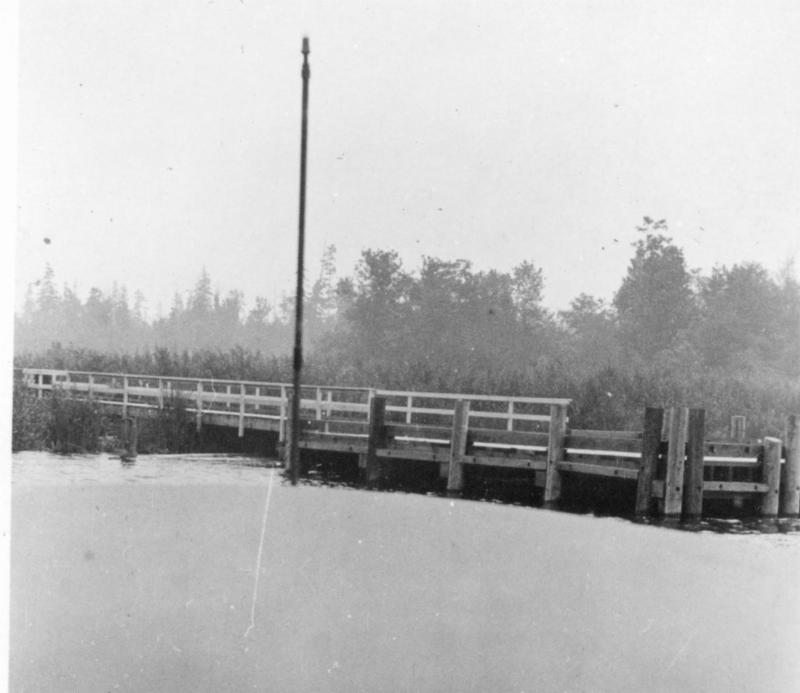
Fairweather Wharf. We'll begin just south of where we left off in Fairweather Bay, between Hunts and Evergreen points, with the strange case of the Fairweather Wharf. Where today there is an engineered yacht basin between the two points, there was originally a wetland. In 1918, after Lake Washington was lowered and the wetland more fully exposed, King County decided that a wharf was needed at this location. This required construction of an elaborate structure--the Boddy-Hindle Trestle--across the wetland, with a spur to the wharf.

While the Boddy-Hindle Trestle became an important route through the Points, linking Evergreen Point to the base of Hunts Point, where there was a school and market, the wharf was never much used. No one lived in the immediate area and more convenient wharves were available on the points.

The image shows Fairweather Wharf when it was relatively new, with the section to the left leading to the Boddy-Hindle Trestle. A wharf inspector's report from 1930 indicates that the wharf is badly rotted and that everything above the water needed replacing. An inspector's report from 1946 indicates that the wharf had completely disappeared and no sign of it remained. The inspector was not bothered, though, noting that the wharf "was in a location not suitable for any reasonable construction supported by piling or otherwise."

304-jpg.jpg

Evergreen Point-Lake Lane . This pier served Evergreen Point and was a regular stop for the steamer Ariel. Its origin seems somewhat uncertain, as the Wharf Inspector of 1946 cannot find records of it having been built by King County. By 1946 ferry service had ended and the inspector noted that the pier was used for public access to the lake for swimming and boating--activities of which he approved! This location remains a public dock maintained by the City of Medina. (Photo courtesy of Washington State Archives)

Old Medina Dock-jpg.jpg

Original Medina dock . Medina enjoyed regular ferry service from Seattle as early as the 1890s, with this robust pier at the foot of what is today N.E. 8th Street, near the "Green Store" and post office. The lakefront land for the wharf was donated to the county by Thomas Dabney, one of the first residents of the area. When a new car ferry landing was built to the south, the new owner of the Dabney property, Captain Elias Johnston, went to great lengths to reclaim the land from the county.

Old Medina car jpg.jpg

First Medina car ferry landing . The Port of Seattle introduced car ferry service to Medina and Bellevue in 1913, and this was the original wharf at the foot of Evergreen Point Road. This pier was left high and dry just a few years later when Lake Washington was lowered by nine feet with the opening of the new Ship Canal. The identity of the child on the beach is not known.

Medina ferry dock 1937-jpg2.jpg

Medina Ferry Terminal . Following the lowering of Lake Washington and the exposure of new shoreline, King County built a new car ferry dock and terminal building. The original dock was built immediately adjacent to the terminal building and later moved to the south as shown in this image. When ferry service ended, the terminal building became a community clubhouse and, later, Medina City Hall. A much-remodeled city hall and beach park remain on the site today.

clyde wharf 1908-jpg.jpg

Clyde landing, Meydenbauer Bay, Bellevue. This pier stood at the foot of Clyde Road (now 92nd Avenue NE), which was named by an early resident with Scottish roots. It is not clear how much ferry service was provided to this location, as it is close to the main Bellevue dock. But the property did remain in public ownership and was converted into Clyde Beach Park, which is maintained by the City of Bellevue.


Learn more about the Eastside. Books available from Eastside Heritage Center include:

Lake Washington: The Eastside

Bellevue: the Post World War II Years

Our Town, Redmond

Medina

Hunts Point

Bellevue: Its First 100 Years


Our Mission To steward Eastside history by actively collecting, preserving, and interpreting documents and artifacts, and by promoting public involvement in and appreciation of this heritage through educational programming and community outreach.

Our Vision To be the leading organization that enhances community identity through the preservation and stewardship of the Eastside’s history.


Eastside Heritage Center is supported by 4 Culture
Eastside Heritage Center is supported by 4 Culture

Eastside Stories: Eastsiders Pay the Toll

No. 7 | May 1, 2019

Eastside Stories

Eastsiders Pay the Toll

Eastside Stories is our way of sharing Eastside history through the many events, people places and interesting bits of information that we collect at the Eastside Heritage Center. We hope you enjoy these stories and share them with friends and famil…

Eastside Stories is our way of sharing Eastside history through the many events, people places and interesting bits of information that we collect at the Eastside Heritage Center. We hope you enjoy these stories and share them with friends and family.

When tolls made their reappearance on the Evergreen Point floating bridge in 2011, many commuters traveling to and from the Eastside were not happy. But this was really a return to the historic norm: for most of Eastside history, it has cost something to take a car across Lake Washington.

All the early passenger steamers charged a fare, of course, and with the introduction of car ferries to Kirkland, and then to Bellevue and Medina, cars could cross the lake at a price. A ferry schedule for both routes from 1930 shows a fare of 50 cents one way and 75 cents round-trip for “light cars” and 60 cents one way and 90 cents round-trip for “heavy cars,” the cut-off point between light and heavy being 2,600 pounds. 

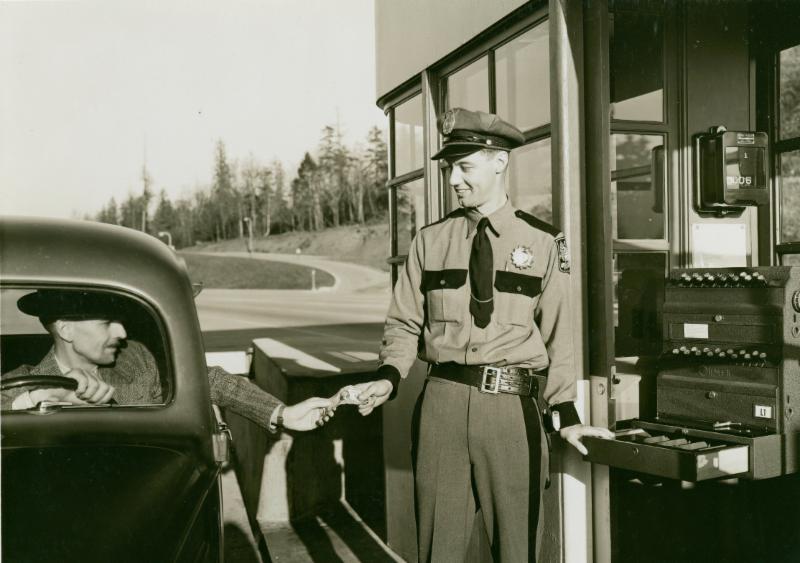
The Seattle-Medina ferry came to an end in 1940 when the new floating bridge opened between Mercer Island and Seattle. And as with most major bridge projects funded by state bond issues, it came with tolls. The toll plaza was located at the first turn onto Mercer Island from the floating bridge, and the toll was set at 25 cents for the car and driver, and another five cents for each passenger. The state removed the tolls when the bonds were retired in 1949.

The new bridge offered a much faster trip across the lake, and one at half the fare. The loss of the ferry turned Medina into a bit of a backwater, and the the new bridge raised the profile of the sleepy village of Bellevue.

A cheerful toll collector greets a driver heading across Mercer Island to Seattle in 1940.

A cheerful toll collector greets a driver heading across Mercer Island to Seattle in 1940.

By the mid-1950s, when the massive developments at Lake Hills, Eastgate and Newport Hills began to lure families “over the bridge and to a new way of living,” there were no tolls on the Mercer Island bridge and the commute to Seattle was an easy one.

By the late 1940s, as the Mercer Island bridge was filling up faster than planned, thoughts of a new bridge began to bubble up among Eastside leaders. Meanwhile, on the other side of the country, Congress was hashing out the National Interstate and Defense Highways Act that provided 90 percent of the funding for a national network of freeways.

States could keep tolls on existing bridges and turnpikes that were incorporated into the new Interstate network, but newly built Interstate freeways were supposed to be toll-free: Interstate 90 across Mercer Island would never have tolls, even on the new and very expensive bridge that opened in 1989.

 
Toll plaza on Mercer Island, looking across Lake Washington to Seattle

Toll plaza on Mercer Island, looking across Lake Washington to Seattle

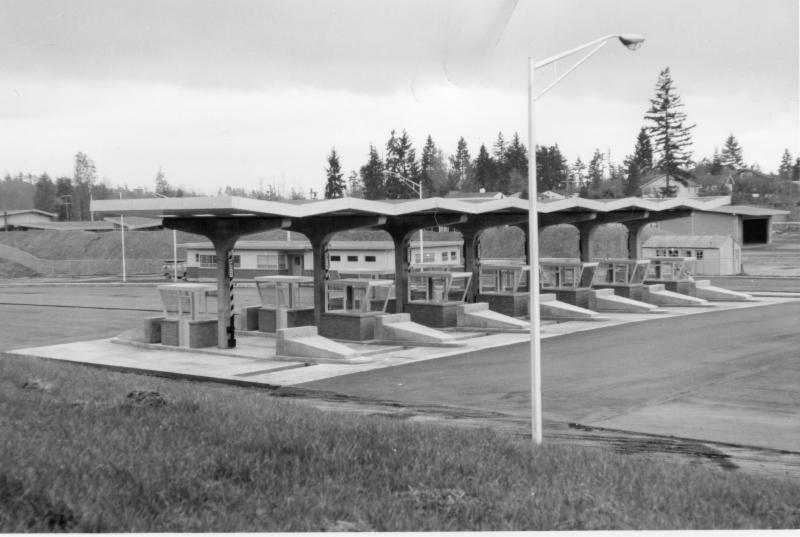
The same could not be said for the new SR-520 corridor planned from Seattle to Redmond. It would not be part of the Interstate system and would need to be funded in-state. So, once again, tolls entered the picture. The new Evergreen Point Bridge, opened in 1963, had a toll plaza in Medina and collected 35 cents per car, with no extra toll for passengers. Commuters could purchase books of tickets that cost about 19 cents each. To encourage ridesharing during the energy crisis of the 1970s, tolls were reduced to 10 cents for cars with two or more passengers.

 
Toll plaza for the Evergreen Point bridge in Medina

Toll plaza for the Evergreen Point bridge in Medina

The ticket books led to one of the more curious criminal enterprises in Eastside history. In the early 1970s, a group of toll collectors began to purchase those 19 cent tickets and swap them for the 35 cent cash tolls they collected, which then went into their pockets. Over time, these 16 cent “profits” added up to many thousands of dollars. The perpetrators were eventually caught and a number of well-known faces in the tollbooths disappeared.

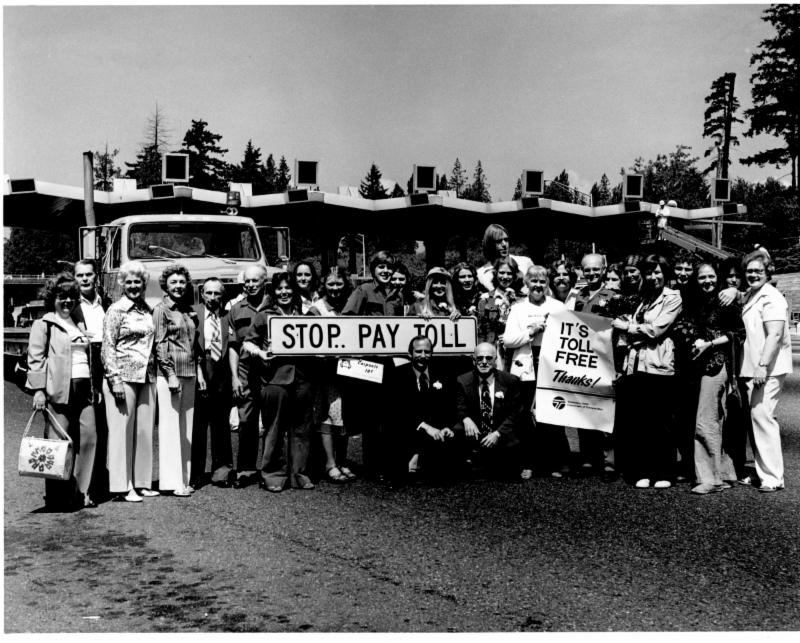
As with the bridge over Mercer Island, traffic volumes on SR-520 exceeded expectations and the state retired the construction bond early. Tolls came off the bridge in June of 1979.

It took some significant changes in state law to return tolls to the original SR-520 bridge in order to fund the new bridge that had not been built yet. And we can safely assume that those tolls will remain in place long after construction bonds for the new bridge are paid off.

Dignitaries celebrate the end of tolls on the SR-520 bridge in 1979. 32 years later, tolls would reappear, but without a toll plaza or toll collectors.

Dignitaries celebrate the end of tolls on the SR-520 bridge in 1979. 32 years later, tolls would reappear, but without a toll plaza or toll collectors.

Economists love tolls, as do government officials charged with paying for really expensive infrastructure. The popular (too popular?) Express Toll Lanes on Interstate 405 would seem to signal that the Eastside will see more, rather than fewer, tolls in the future.


Note on photos. All images in this article are the property of the Washington State Department of Transportation and are in the public domain. These images have appeared in EHC books. The Eastside Heritage Center has a vast collection of images that it owns, but also uses images from public domain sources to help tell its stories.

If you would like to display historic images in your home or business or use them in publications or presentations, please contact us at collections@eastsideheritagecenter.org


Learn more about the Eastside. Books available from Eastside Heritage Center include:

Lake Washington: The Eastside

Bellevue: the Post World War II Years

Our Town, Redmond

Medina

Hunts Point

Bellevue: Its First 100 Years


Our Mission To steward Eastside history by actively collecting, preserving, and interpreting documents and artifacts, and by promoting public involvement in and appreciation of this heritage through educational programming and community outreach.

Our Vision To be the leading organization that enhances community identity through the preservation and stewardship of the Eastside’s history.


Eastside Heritage Center is supported by 4 Culture

Eastside Heritage Center is supported by 4 Culture

Eastside Stories: Coal Mining on the Eastside

No. 6 | April 17, 2019

Eastside Stories

Coal Mining on the Eastside

Eastside Stories is our way of sharing Eastside history through the many events, people places and interesting bits of information that we collect at the Eastside Heritage Center. We hope you enjoy these stories and share them with friends and famil…

Eastside Stories is our way of sharing Eastside history through the many events, people places and interesting bits of information that we collect at the Eastside Heritage Center. We hope you enjoy these stories and share them with friends and family.

Newcastle, Coal Creek, Black Diamond. These place names in King County did not spring up by accident. They reflect the importance of coal mining in the evolution of the Puget Sound region in the nineteenth and early twentieth centuries.

While pioneers were carving homesteads and logging camps out of the wilderness around Puget Sound, the Industrial Revolution was in full swing. And that revolution was powered by coal. Coal fired steam engines, smelted iron and heated the urban homes and factories that were coming to dominate American life. These industries and innovations were slow to come to the West Coast, but when they did, they needed a reliable supply of high quality coal.

Such supplies were found in the foothills of the Cascade Mountains. Coal deposits had been discovered around the state and in British Columbia by the earliest explorers, and in 1859, just eight years after the first settlers established the new city of Seattle, coal was discovered in Issaquah. It took three more years for an enterprising miner to get a few loads to Seattle. Coal was discovered near Lake Washington—and easier transport to Seattle—in 1863, and the rush was on. This area would be dubbed Coal Creek and would be the site of mining for decades.

Mining camp at Coal Creek in 1910. (Photo courtesy of City of Seattle Archives.)

Mining camp at Coal Creek in 1910. (Photo courtesy of City of Seattle Archives.)

Scale was a problem at first. Seattle, at that time, was still a small place, with a limited number of houses and businesses that could afford coal--wood was still plentiful and cheap. And there was not a whole lot of capital to invest in mines and transportation infrastructure. But as with so many of the region’s dilemmas in the nineteenth century, the answer would come from California.

The same booming San Francisco Bay economy that was absorbing wood products from Puget Sound would absorb the coal being dug out of its hillsides. And investors from California, with piles of Gold Rush wealth, would supply the capital to make the mines of the Eastside and Southeast King County hum.

Mines began to operate from Newcastle to Renton and south into Pierce County (the town of Carbonado did not get its name by accident either). Railroads gradually came to the area, significantly lowering the cost of transporting coal. And towns sprung up, housing miners and their families, many of whom had immigrated from Europe and Asia.

 
This tramway in Newcastle transported coal to barges on Lake Washington, (Eastside Heritage Center Photo)

This tramway in Newcastle transported coal to barges on Lake Washington, (Eastside Heritage Center Photo)

In many ways, coal shaped the Seattle area as significantly as timber. Whereas lumber and logs were shipped from the anchorage closest to the source, coal was shipped primarily from the docks of Elliott Bay, helping develop the port. Railroads and regular steamship service to Asia arrived in Seattle in the early 1890s, and by 1910, Seattle was the third largest port in the country (after New York and Philadelphia) and the primary West Coast gateway to Asia. Local coal fired all those ship and locomotive boilers.

Local coal also drove one of the more curious economic development schemes in the region’s history: the Great Western Iron and Steel Company of Kirkland. With coal and newly-discovered iron ore in the Cascades, a group of investors set out to create the “Pittsburgh of the West” atop Rose Hill. This is a long story that will be told later, but suffice to say that without local coal, Kirkland might not have emerged as the leading city of the young Eastside.

The coal mines of the Eastside have been closed for decades, but the old shafts can still be visited on Cougar Mountain, and there is evidence of the old townsites and camps, if you know where to look.

Presentations, tours and field trips with EHC’s expert volunteers and staff can be arranged. Contact our education staff.


The bulk freighter Dominion takes on a load of coal at a bunker on the Seattle waterfront in 1910. (Photo courtesy of City of Seattle Archives)

The bulk freighter Dominion takes on a load of coal at a bunker on the Seattle waterfront in 1910. (Photo courtesy of City of Seattle Archives)


Learn more about the Eastside. Books available from Eastside Heritage Center include:

Lake Washington: The Eastside

Bellevue: the Post World War II Years

Our Town, Redmond

Medina

Hunts Point

Bellevue: Its First 100 Years


Our Mission To steward Eastside history by actively collecting, preserving, and interpreting documents and artifacts, and by promoting public involvement in and appreciation of this heritage through educational programming and community outreach.

Our Vision To be the leading organization that enhances community identity through the preservation and stewardship of the Eastside’s history.


Eastside Heritage Center is supported by 4 Culture

Eastside Heritage Center is supported by 4 Culture

Eastside Stories: Ferry Landings of Lake Washington

No. 5 | April 3, 2019

Eastside Stories

Eastside Stories is our way of sharing Eastside history through the many events, people places and interesting bits of information that we collect at the Eastside Heritage Center. We hope you enjoy these stories and share them with friends and famil…

Eastside Stories is our way of sharing Eastside history through the many events, people places and interesting bits of information that we collect at the Eastside Heritage Center. We hope you enjoy these stories and share them with friends and family.

Ferry Landings of Lake Washington, Part I

The first edition of Eastside Stories described the ferries that connected the Eastside to Seattle before the floating bridges. These vessels had to land somewhere, and we'll begin the story of the ferry landings on the east side of Lake Washington.

Captain Robert Matson, who began working on Lake Washington ferries as a boy, drew up a map that shows over 30 formal wharves from Juanita to Kennydale in service in 1909. Many other known docks are not shown on his map, so it would be safe to say that well over three dozen formal stops existed on the Eastside at one time or another. This large number of stops makes sense for a couple of reasons.

First, there were few roads around the Eastside at the time, so once off the ferry, it would be tough to travel far. Life around the lake was really oriented toward the water. Front doors were on the water side and in some areas property owners were required to grant easements on their shoreline so local residents could walk along the beach to the ferry.

Second, most of the ferry service was via passenger steamer, with vehicle service offered only to Kirkland, Medina and Bellevue. So ferries needed to drop their passengers off close to home.

Many of these landings exist only in distant memories or on sketches like Captain Matson’s. But others have remained in public ownership and are now enjoyed as parks and fishing piers, sometimes known mostly to the neighbors.

Following are five of the wharves on the north end of the lake. In future editions, we’ll look at wharves on the southern half of the lake as well as on Mercer Island and in Seattle.

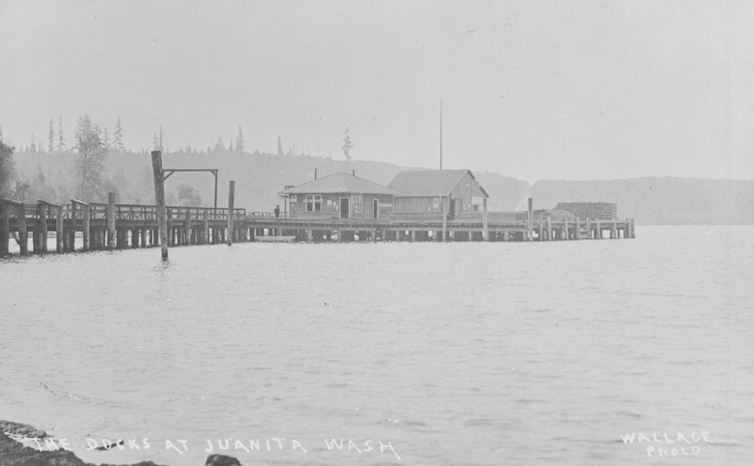
Juanita Bay . Juanita, originally known as Hubbard, was settled in the 1870s as a farming and timber community. It later became a popular beach that attracted people from around the area. Juanita Bay itself is quite shallow, so the wharf had to be built some distance from the shore. A stack of cordwood to fuel the steamers is visible at the end of the pier.

Kirkland . As the major city of the Eastside, Kirkland was the first to get vehicle ferry service in 1905. (In that year, most of the vehicles would have been horse-drawn wagons). And Kirkland was the last Eastside community to enjoy car ferry service , which ended in 1950, ten years after the Mercer Island bridge had opened. The Kirkland ferry dock was located where the current public pier sits in downtown Kirkland.

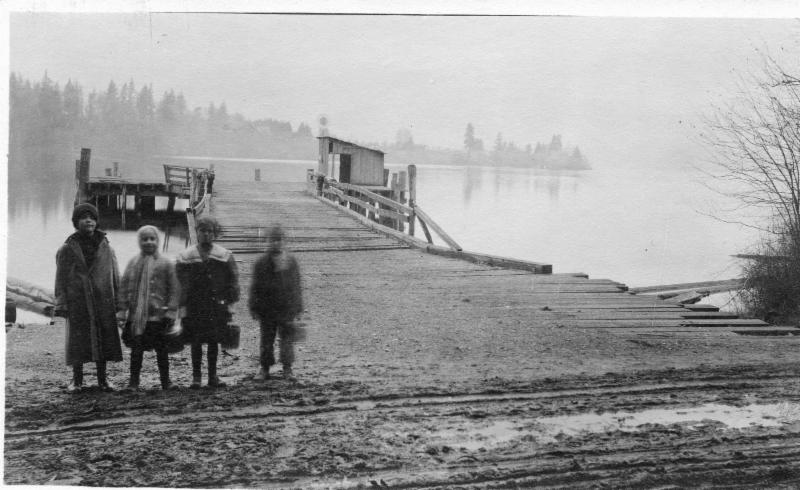
Northup . This pier, among the earliest on the Eastside, was situated on the east side of Yarrow Bay in the community of Houghton. (Yarrow Point and Hunts Point are in the background.) The Northups and several other families settled the area in the 1870s. These children would have attended the Houghton School which was just to the north of the ferry landing or the Northup School further to the south.

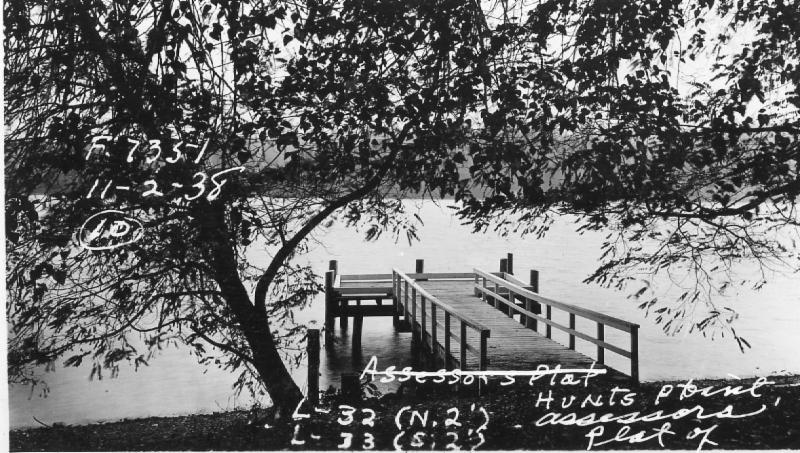
Penrose Landing, Hunts Point . Hunts Point had more than its share of ferry landings because it had a relatively large number of daily commuters, at least in the summer months. This landing was on the east side of Hunts Point, in Cozy Cove. A passenger who missed the ferry here could run across the point to the Club House dock and likely make it there before the ferry rounded the point. (Photo courtesy of Washington State Archives)

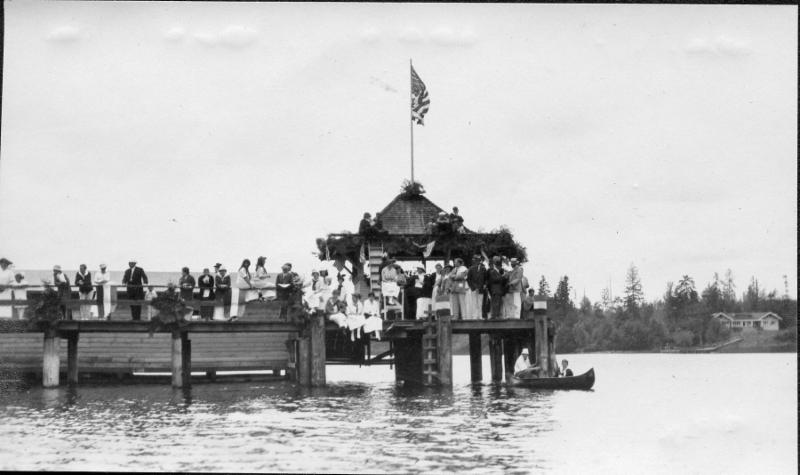
Club House dock, Hunts Point . This image shows the Club House dock on Fairweather Bay, during an Independence Day celebration in 1915. (Photo courtesy of Town of Hunts Point)


Learn more about the Eastside. Books available from Eastside Heritage Center include:

Lake Washington: The Eastside

Bellevue: the Post World War II Years

Our Town, Redmond

Medina

Hunts Point

Bellevue: Its First 100 Years


Our Mission To steward Eastside history by actively collecting, preserving, and interpreting documents and artifacts, and by promoting public involvement in and appreciation of this heritage through educational programming and community outreach.

Our Vision To be the leading organization that enhances community identity through the preservation and stewardship of the Eastside’s history.


Eastside Heritage Center is supported by 4 Culture

Eastside Heritage Center is supported by 4 Culture